What Is the KEPEAK 100W Portable Solar Panel?
The KEPEAK 100W Portable Solar Panel is a foldable, high-efficiency monocrystalline solar charger designed for portable use. It features A+ monocrystalline solar cells achieving up to 23.5% conversion efficiency, and it's built to be waterproof, dustproof, and wear-resistant — making it ideal for unpredictable environments including rain, storms, and rugged camping conditions.
It targets a broad user base: weekend campers, full-time RV travelers, off-grid homesteaders, van lifers, and emergency preparedness households. Its appeal lies not in doing one thing brilliantly, but in doing many things reliably and without fuss.
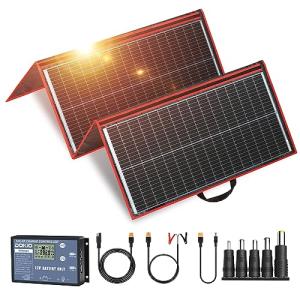
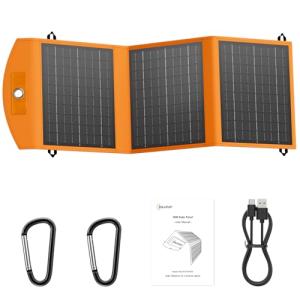
The panel connects to most popular portable power stations through a 4-in-1 DC cable, and it can also charge devices directly via USB-A (QC3.0) and USB-C (PD) ports — no middleman required.
Design and Build Quality: Built to Take a Beating
One of the first things you notice about the KEPEAK 100W is that it doesn't feel flimsy. The surface is treated with an ETFE laminate coating — a material commonly used in aerospace and architecture for its exceptional durability, UV resistance, and light transmittance. This isn't the crinkly, plasticky feel of budget solar panels. It's a surface that's meant to live outdoors.
The panel is waterproof, dustproof, and wear-resistant, making it suitable for rain, storms, and rugged camping conditions. That kind of weatherproofing matters enormously when you're dealing with coastal fog, mountain afternoon thunderstorms, or the inevitable moment when your gear takes an unexpected soaking.
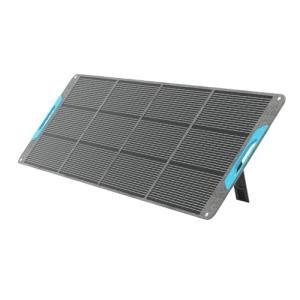
The foldable design is genuinely clever. When unfolded, it maximizes sun-facing surface area. When folded, it compresses into a manageable footprint you can slip into a pack, lean against an RV wall, or toss in a truck bed. The carry handle allows one-handed transport, and the integrated kickstands let you angle the panel toward the sun without needing rocks or improvised props.
The stitching on the fabric backing and the hinge construction feel durable — not afterthought durable, but purposefully engineered for repeated folding and unfolding over months of use.
The Efficiency Story: 23.5% — What Does That Actually Mean?
Solar panel efficiency is one of those specs that gets thrown around a lot without much explanation. Here's what it actually means for you.
Featuring A+ monocrystalline solar cells, this folding solar panel achieves up to 23.5% conversion efficiency, delivering reliable energy even on cloudy days. For context, budget polycrystalline panels typically land around 15–17% efficiency. Standard monocrystalline panels hover at 18–21%. Hitting 23.5% puts the KEPEAK in the upper tier of portable consumer solar panels.
In practical terms, higher efficiency means the panel extracts more usable energy from the same amount of sunlight hitting its surface. This matters most in two scenarios: when sun angles are suboptimal (early morning, late afternoon, overcast days), and when space is limited and you can't simply lay out a larger panel.
A 100W panel with 23.5% efficiency charging under good conditions can realistically deliver 70–85 actual watts to a power station depending on cable losses and station input limits. Over a five-hour peak sun window, that's 350–425 watt-hours of energy — enough to meaningfully charge a 300–500Wh portable power station from a significant deficit.
Don't expect miracles in deep shade or under heavy cloud cover, but in partial cloud or dappled forest light, the KEPEAK holds up better than lower-efficiency alternatives.
Charging Ports and Connectivity: More Versatile Than It Looks
This is where the KEPEAK 100W earns some genuine points over competitors at similar price points. The panel is equipped with multiple output options, making it one of the more versatile portable solar chargers available without stepping up to premium-tier pricing.
Equipped with USB-A, USB-C, and DC outputs, the built-in intelligent IC chip automatically regulates charging to protect your devices. The QC3.0 USB-A port delivers fast charging to compatible smartphones — cutting down charge times significantly compared to standard 5W charging. The USB-C PD port handles power delivery for modern laptops, tablets, and newer smartphones that have moved past the barrel connector era.
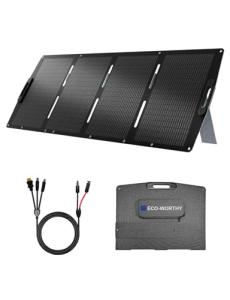
The panel includes a 4-in-1 DC cable (Anderson, XT60, DC5521, DC7909), making it compatible with most popular power stations. This is a meaningful inclusion. Many budget panels ship with a single DC connector, leaving you scrambling for adapters when your power station uses a different port type. Having Anderson, XT60, DC5521, and DC7909 connectors in the box means you can plug into a Jackery, EcoFlow, Bluetti, Anker, or Rockpals unit on day one without a hardware store run.
The intelligent IC chip is worth calling out specifically. Rather than dumping current at a fixed rate and hoping your device handles it, the chip detects what's connected and adjusts output accordingly. This provides meaningful protection against overcharging, over-voltage, and overheating — particularly important when you're leaving devices charging unattended at a campsite.
Real-World Use Cases: Where the KEPEAK 100W Shines
RV Travel
RV travelers are arguably the sweet spot user for this panel. You have a vehicle for transport, so weight is less of a concern than it would be for a backpacker. You need reliable daily charging for phones, laptops, CPAP machines, mini-fridges, and portable power stations. And you're frequently in variable sun conditions — parked in partial shade, moving to new sites, dealing with regional weather.
This camping solar panel is described as perfect for RV travel, road trips, off-grid living, and emergency use. The kickstand design lets you position the panel independently of your RV's orientation — you don't need to park perfectly south-facing to get good output. Set it outside while you're connected to shore power, and let it top off your auxiliary battery bank throughout the day.
Camping and Overlanding
For car campers and overlanders, the KEPEAK 100W is a strong pairing with any 300–600Wh portable power station. Deploy it each morning while you make coffee, and by midday, you've recovered most of the previous night's energy consumption. The foldable format packs efficiently into a tailgate kit, and the weatherproofing means you're not rushing to cover it every time clouds roll in.
Backpackers may find this panel on the heavier end for their needs — 100W portable panels generally weigh in the 7–10 lb range, which is significant for multi-day foot travel. For base camp setups or car-supported trips, though, the weight-to-output ratio is excellent.
Emergency Preparedness
This is the use case that doesn't get enough attention in solar panel marketing. Grid-down events — whether from hurricanes, ice storms, wildfires, or infrastructure failures — are becoming more frequent and more prolonged. A 100W portable solar panel paired with a modest power station gives a household the ability to keep phones charged, run medical devices, power LED lighting, and maintain communication during an extended outage.
The panel is described as a dependable power source for extended camping trips or emergency backup situations. Storing a folded solar panel in a closet or garage takes minimal space, and unlike a generator, it requires no fuel, produces no exhaust, and makes no noise. For households in high-risk weather zones, this is a genuinely compelling emergency preparedness investment.
Smart and Safe Charging Technology: Under the Hood
Modern portable solar panels live or die by the quality of their charging management, and KEPEAK has paid attention here. The QC3.0 standard — developed by Qualcomm — enables charging rates of up to 18W on compatible devices compared to the 5W ceiling of standard USB charging. For a flagship smartphone, that's the difference between a full charge in 30 minutes versus nearly two hours.
The USB-C PD (Power Delivery) port opens up charging for larger devices. Laptops, iPads, and high-capacity power banks that previously couldn't be practically charged by a solar panel directly are now viable. The PD protocol negotiates voltage and current between the panel and the device, extracting the fastest safe charging rate for whatever's connected.
The built-in intelligent IC chip serves as the referee for all of this. It monitors the charging session in real time and intervenes if anything falls outside safe parameters — a necessary safeguard when you're dealing with variable solar input that can spike and dip throughout the day.
Comparison Table: KEPEAK 100W vs. Top Competitors
Here's how the KEPEAK 100W stacks up against the leading alternatives in the portable 100W solar panel space:
| Feature | KEPEAK 100W | FlexSolar 100W | ZOUPW 100W | Nicesolar 100W |
|---|---|---|---|---|
| Efficiency | 23.5% | 23%+ | 23.5% | Up to 23% |
| Cell Type | A+ Monocrystalline | Monocrystalline ETFE | A+ Monocrystalline | PERC A-grade Mono |
| Waterproofing | Weatherproof (Waterproof) | IP67 | IP67 | IP67 |
| USB-A Port | QC3.0 | QC3.0 (18W) | QC3.0 | QC3.0 |
| USB-C Port | PD | PD3.0 (45W) | PD (15V/3A) | PD 65W |
| DC Output | 4-in-1 cable included | 4-in-1 cable included | 4-in-1 cable included | DC 21V |
| Connectors | Anderson, XT60, DC5521, DC7909 | DC5521, DC7909, Anderson, XT60 | Anderson, XT60, DC5521, DC7909 | Standard DC |
| Foldable | Yes | Yes | Yes | Yes |
| Kickstand | Yes | Yes | Yes | Yes |
| Intelligent IC Chip | Yes | Yes | Yes | Yes |
| Best For | RV, Camping, Emergency | Camping, Emergency | Camping, Power Stations | Camping, Laptop Charging |
| Laptop Direct Charging | Yes (via PD) | Yes (PD3.0) | Yes (PD) | Yes (USB-C 15–20V) |
The KEPEAK holds its ground well across the board. Where FlexSolar edges ahead is in its IP67 certified waterproof rating — a formal certification versus KEPEAK's stated weatherproofing. Nicesolar stands out for its higher-wattage USB-C PD port at 65W, which is better for power-hungry laptops. ZOUPW is a strong all-around alternative with comparable specs.
For most buyers, the KEPEAK's combination of 23.5% efficiency, comprehensive connector bundle, dual fast-charge ports, and proven weatherproofing positions it as one of the stronger value propositions in this segment.
Who Should Buy the KEPEAK 100W — And Who Should Look Elsewhere
Buy it if:
You're an RV traveler who needs reliable daily charging without permanent panel installation. The foldable format and comprehensive connector bundle make setup and teardown genuinely fast, and the weatherproofing means you're not babysitting it every time clouds roll through.
You're building an emergency preparedness kit. A 100W panel is a meaningful upgrade over smaller emergency chargers, and the direct USB charging capability means you don't absolutely need a power station to get value from it in a pinch.
You camp frequently with a portable power station and want to maximize daytime recharging. The 23.5% efficiency means you're extracting more energy per hour than most panels in this class.
You want a panel that charges devices directly as well as feeding a power station. The QC3.0 and PD ports mean this panel pulls dual duty without extra hardware.
Look elsewhere if:
You're a thru-hiker or ultralight backpacker. At this wattage, portable panels aren't designed for that use case. A 15–25W ultralight panel is a better fit.
You need formal IP67 or IP68 waterproof certification for extreme marine environments or situations where the panel will be fully submerged. The KEPEAK is weatherproof but may not carry the same lab-certified rating as some competitors.
You have a very large power station (600Wh+) and want to chain panels. A single 100W panel will charge a large station, but slowly. Consider whether a 200W or dual-panel configuration makes more sense for your energy needs.
Setting Up the KEPEAK 100W: Easier Than You'd Expect
One of the quiet wins of the KEPEAK design is how fast it goes from bag to charging. Unfold it, extend the kickstand, orient it toward the sun, and plug in — the whole process takes about 90 seconds with zero learning curve. There's no app to configure, no separate controller to install, and no wiring harness to wrestle with.
The kickstand angle adjustment lets you optimize for the sun's position throughout the day. If you're stationary for a full day, tilting the panel south and adjusting the angle to match your latitude can meaningfully increase total energy harvest compared to leaving it flat on the ground.
The 4-in-1 cable ships inside the panel's carry case, so you don't have to track it separately. Plug the DC cable into your power station's solar input port, match the connector to your station type, and you're charging.
One pro tip worth noting: check your power station's maximum solar input wattage before you buy. Some stations cap solar input at 60W or 65W regardless of panel output. If your station has a 60W solar input limit, you'll harvest 60W maximum even with a 100W panel — the panel itself isn't the bottleneck, the station is.
Maintenance and Longevity: Set It and Mostly Forget It
Portable solar panels with ETFE laminate surfaces are among the lower-maintenance pieces of outdoor gear you can own. The surface doesn't absorb water, resists UV degradation, and wipes clean with a damp cloth. Bird droppings, dust, and pollen — the usual culprits of reduced output — come off easily without specialized cleaners.
The absence of glass in the surface construction also means you're not dealing with fragile rigid panels that crack if dropped or knocked over. The fabric-backed foldable format is considerably more forgiving in that regard.
Long-term efficiency degradation in quality monocrystalline panels is typically around 0.5% per year — meaning a panel that produces 100W today should still produce around 95W after a decade of regular use. Whether KEPEAK offers a formal warranty should be confirmed at point of purchase, but the underlying cell technology has a strong track record for longevity.
The Bigger Picture: Why Portable Solar Is No Longer a Niche Product
The context around portable solar panels has shifted meaningfully in recent years. Portable power stations have become significantly more capable and more affordable, making the solar panel + power station combination a practical off-grid energy system rather than an enthusiast toy. Grid reliability in parts of the United States, Australia, and Europe has become a real concern for ordinary households. Campsite electricity hookups are increasingly competitive and expensive at popular parks.
All of this has created a legitimate mass market for products like the KEPEAK 100W — not just for adventure seekers, but for pragmatic households thinking about resilience. A 100W panel and a 500Wh power station represent a reasonable rainy-day investment that also doubles as camping gear, fishing trip gear, and tailgate power.
The technology has matured to the point where 23.5% efficiency, QC3.0 fast charging, and weatherproof construction are available at accessible price points. That's a genuine shift from five years ago, when similar specs would have been found only in premium panels at significantly higher cost.
A Dependable, Well-Rounded Portable Solar Panel
The KEPEAK 100W Portable Solar Panel doesn't try to be the most extreme panel on the market. It doesn't claim IP68 submersion ratings or 25% efficiency. What it offers is a well-balanced package of real-world performance, versatile connectivity, durable construction, and genuine ease of use — at a price point that makes the math work for most buyers.
The 23.5% monocrystalline efficiency delivers strong output across a range of lighting conditions. The QC3.0 and PD fast-charging ports mean you're not waiting hours for a phone to top up. The 4-in-1 connector bundle handles compatibility with most power stations right out of the box. And the weatherproof foldable design means it handles real outdoor conditions without requiring careful handling.
For RV travelers, frequent campers, overlanders, and emergency preparedness households, the KEPEAK 100W is a genuinely useful piece of kit that will pay for itself in convenience and peace of mind across its lifespan.
→ Check the current price and availability of the KEPEAK 100W Portable Solar Panel on Amazon