Why the Hardware Decision Is the Hardest Part Nobody Talks About
Everyone talks about solar panels. The sleek black rectangles on the roof, the lower electricity bills, the environmental virtue. What nobody talks about — at least not with enough seriousness — is everything that happens before the panels go up. The wiring decisions. The inverter choices. The battery question that every homeowner eventually asks at 11pm while reading Reddit threads. The fundamental architectural decision between being tied to the grid or cutting loose from it entirely.
This is the part of solar that actually determines whether your system runs like a well-tuned instrument or becomes a source of chronic frustration. And it looks completely different depending on whether you're installing panels on a suburban ranch home or on the roof of a 40,000-square-foot warehouse.
This guide covers the real substance of solar installation and system design — the technical decisions, the tradeoffs, the comparisons that most solar salespeople gloss over.
Residential vs. Commercial Solar: Same Technology, Completely Different World
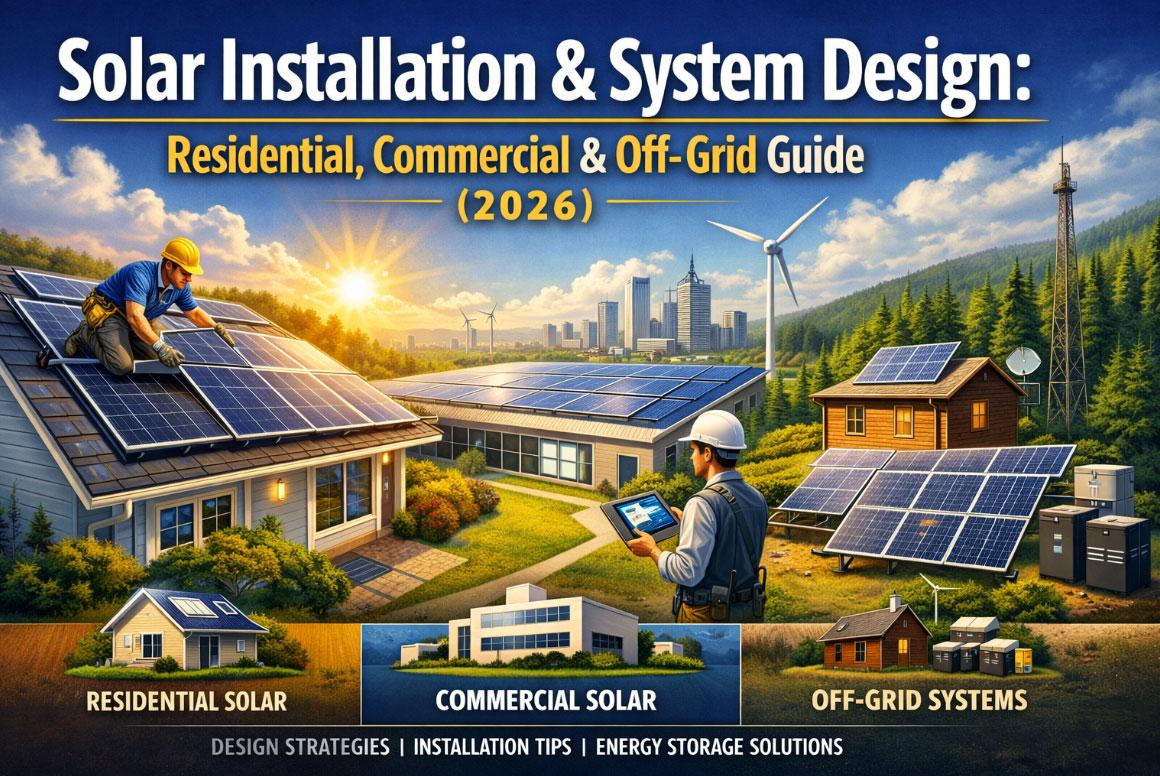
At first glance, residential and commercial solar seem like variations on a theme. Panels, inverters, wiring, sunshine. But the engineering philosophy behind a rooftop system for a family of four and a ground-mounted array for a manufacturing facility are so different they almost deserve separate conversations.
Residential Solar — Optimized for Simplicity and Long-Term Value
The typical residential solar installation is a 6–12 kW system, sized to offset most or all of a household's annual electricity consumption. The roof is the platform. The family's usage patterns — highest demand in the morning and evening, lower during the middle of the day when the system is actually producing peak power — create an inherent mismatch that shapes every design decision.
Residential systems in the United States are dominated by three or four major inverter manufacturers, a handful of panel brands, and increasingly, one battery chemistry: lithium iron phosphate (LFP). The permitting process, while improving, still involves local utility approval, city inspections, and in many jurisdictions, a wait that can stretch weeks or months after installation.
For homeowners, the key design constraints are:
- Roof orientation and shading: South-facing roofs in the Northern Hemisphere capture the most annual energy. But partial shading from a chimney or neighboring tree can devastate a poorly designed string system.
- Panel count vs. available roof space: Most residential roofs can physically accommodate more panels than the utility will allow based on a "120% rule" that caps system size at 120% of annual usage.
- Aesthetic considerations: This matters more than engineers like to admit. Flush-mounted systems sell houses better. Homeowners care about how things look.
Commercial Solar — Where Engineering Gets Serious
Commercial systems start at around 50 kW and scale to megawatts. The platform shifts from asphalt shingles to membrane roofing, carports, open land, or some combination of all three. The electrical infrastructure is three-phase. The financial model involves not just reduced bills but demand charge management — avoiding the peak power spikes that utilities charge commercial customers disproportionately for.
Commercial installations involve a different caliber of engineering documentation: load studies, structural analyses, utility interconnection studies, and in many cases, environmental impact assessments. A commercial solar developer might spend 12–18 months in pre-development work before a single panel is installed.
The business case is also different. A homeowner is thinking in terms of payback period (typically 7–10 years) and monthly bill savings. A commercial property owner is running IRR calculations, thinking about depreciation under the Modified Accelerated Cost Recovery System (MACRS), and often considering the system as a net operating income driver for the property itself.
Grid-Tied vs. Off-Grid: The Decision That Changes Everything
This is the foundational choice in solar system design. Every other decision — battery size, inverter type, backup capacity — flows from whether you intend to remain connected to the utility grid.
Grid-Tied Systems — The Rational Default for Most Installations
A grid-tied system uses the utility grid as a kind of infinite, always-available battery. When your panels produce more electricity than you're consuming, the excess flows onto the grid and your meter runs backward (or you receive a credit). When you're consuming more than you're producing — at night, on cloudy days, in winter — you draw from the grid.
The appeal is economic efficiency. Grid-tied systems are simpler, require fewer components, and cost significantly less than systems with battery storage. The inverter doesn't need to manage charging and discharging cycles. There's no battery bank to maintain or eventually replace.
The limitation is significant: a grid-tied system without battery backup goes dark when the grid goes down. This is a deliberate safety feature called "anti-islanding protection." If utility workers are repairing power lines and your system is still feeding electricity onto the grid, someone could be killed. So the inverter detects grid loss and shuts down automatically.
For most homeowners in urban and suburban environments with reliable utility service, grid-tied remains the economically rational choice — particularly when paired with a time-of-use electricity rate that rewards self-consumption during peak price hours.
Off-Grid Systems — Freedom Has a Price Tag
An off-grid solar system is exactly what it sounds like: a self-contained power plant with no connection to the utility. The system must produce, store, and manage all the electricity the building will ever need, including during extended cloudy periods, high-demand seasons, and equipment failures.
The battery bank in an off-grid system isn't an optional add-on — it's the load-bearing structural element of the entire design. Sizing it correctly requires understanding daily energy consumption patterns, the number of "autonomy days" (consecutive low-production days the system must handle), and the efficiency losses inherent in charging and discharging.
Off-grid makes obvious sense for remote properties: cabins, agricultural outbuildings, telecommunications towers, rural homes far from the nearest utility line. In these cases, the cost of extending grid infrastructure — which can run $50,000–$100,000+ per mile — makes the economics of a standalone solar system compelling even at significant cost.
Off-grid is also increasingly appealing in regions with unreliable grid infrastructure: parts of Australia, sub-Saharan Africa, rural Southeast Asia. Here, the grid exists but provides power intermittently, making off-grid or hybrid systems a pragmatic solution rather than an ideological choice.
The honest caution: off-grid systems require more attention, more maintenance, more planning, and more money upfront. They are not a set-and-forget solution.
Hybrid Systems — The Practical Middle Ground
A hybrid system — grid-tied with battery backup — has become the dominant design preference for residential solar with storage. The system maintains utility connection and all its benefits while adding a battery bank sized to power critical loads through grid outages or to perform strategic energy shifting (charging batteries during low-rate periods, discharging during high-rate periods).
Modern hybrid inverters from companies like SolarEdge, Enphase, SMA, and Fronius can manage the complexity of this automatically. The homeowner sees a simpler interface: backup power available when needed, optimized self-consumption as a default.
Inverters — The Brain of the Operation
The inverter is the most intellectually interesting component in a solar system. It's the device that converts the direct current (DC) electricity produced by panels into the alternating current (AC) electricity your home or business actually uses. But modern inverters do far more than that.
String Inverters — The Classic Architecture
In a string inverter configuration, multiple panels are wired in series (a "string"), and the combined DC output feeds into a single centralized inverter. It's the oldest and still most widely deployed inverter architecture.
String inverters are robust, well-understood, and relatively inexpensive. The limitation is that the entire string performs at the level of its weakest panel — if one panel is shaded, dirty, or degraded, every other panel in the string is affected. On simple, unshaded south-facing roofs, string inverters remain an excellent choice.
Microinverters — Panel-Level Independence
Microinverters eliminate the string dependency problem by placing a small inverter directly on each panel. Every panel operates independently, so shading or soiling on one panel has no effect on the others.
The advantages extend to monitoring (you get panel-level performance data) and design flexibility (panels on different roof faces with different orientations can be included in the same system without efficiency penalty).
The tradeoffs: higher upfront cost and more components on the roof that theoretically have more failure points — though microinverter manufacturers like Enphase argue their distributed architecture is actually more resilient than a single point of failure in a string inverter.
Power Optimizers — A Hybrid Approach
DC power optimizers (most associated with SolarEdge) attach to each panel and perform maximum power point tracking at the panel level before sending conditioned DC to a central string inverter. This delivers many of the performance benefits of microinverters with the cost profile closer to a string inverter system.
Batteries — The Component That Changes the Equation
Battery storage is transforming what solar systems can do. A solar array without storage is a daylight appliance. A solar array with storage becomes a round-the-clock energy management platform.
Lithium Iron Phosphate (LFP) — The New Standard
LFP batteries have decisively displaced lead-acid in new residential installations and are rapidly gaining ground in commercial applications. The chemistry offers a compelling combination of qualities: 3,000–6,000+ cycle lifespan at full depth of discharge, excellent thermal stability (no thermal runaway), high round-trip efficiency (92–96%), and a flat discharge curve that delivers consistent voltage throughout the discharge cycle.
The Tesla Powerwall, Enphase IQ Battery, and Franklin Electric apower are all LFP-based. So are most utility-scale battery systems deployed in the last three years.
Lead-Acid — Still Alive in Specific Applications
Flooded lead-acid batteries remain relevant in off-grid applications where upfront cost is the dominant constraint, maintenance is acceptable, and the installation environment is appropriate. They are cheap, well-understood, and widely available globally. Their limitations — shorter cycle life, requirement for regular equalization charging, sensitivity to temperature, limited depth of discharge — make them a poor fit for most new residential installations in developed markets.
Sizing the Battery Bank
This is where the math gets important. A properly sized battery bank requires knowing:
- Critical loads: What must continue operating during an outage? Refrigerator, medical equipment, internet, lighting?
- Duration requirement: Is the goal to bridge a few hours until grid restoration, or weather a multi-day outage?
- Solar recharge capacity: How much energy can the array replace each day?
A typical residential backup battery (10–20 kWh) is sized to run critical loads for one to two nights between solar production days. A true off-grid system might require 40–80 kWh or more, depending on consumption and location.
Mounting Options — Engineering Meets Architecture
How panels are attached to a structure affects aesthetics, structural load, production, and maintenance access. The mounting decision is rarely glamorous, but it matters more than most homeowners realize.
Roof-Mounted Systems — The Residential Default
Flush-mounted roof systems use racking that attaches to the structural rafters through the roofing material. The key engineering concern is weatherproofing: every penetration through the roof is a potential leak point. Experienced installers use flashed mounts that redirect water away from penetrations, but installation quality varies dramatically.
Roof tilt-up mounts can adjust the panel angle from the roof pitch to optimize for annual energy production. This improves performance on shallow roofs but creates more wind loading and some would argue, an aesthetic penalty.
Ballasted roof systems (common on flat commercial roofs) use weighted blocks to hold racking in place without penetrating the roofing membrane — a significant advantage on expensive membrane roofs where penetrations are costly to protect.
Ground-Mounted Systems — When the Roof Won't Work
Ground-mounted systems offer orientation and tilt flexibility that roof systems can't match. They're easier to maintain (no ladder required), easier to expand, and can be positioned for optimal sun exposure regardless of which direction the building faces.
The downsides are real: they require land, they change the visual character of a property, and in many jurisdictions they face different permitting requirements than rooftop systems.
Single-axis tracking systems — which rotate panels on an east-west axis to follow the sun through the day — can increase annual energy production by 20–30% compared to fixed-tilt ground mounts. At utility scale, the economics clearly favor tracking. At the residential level, the added cost and mechanical complexity rarely pencil out.
Carport and Canopy Systems
Solar carports solve two problems simultaneously: they generate electricity and provide covered parking. For commercial properties with large parking lots — retail centers, office campuses, universities, municipalities — carports represent a significant untapped solar resource without consuming roof or land that might have competing uses.
The structural engineering is more complex than rooftop or ground-mount, and the cost per watt is higher, but the dual-use value proposition is compelling. Some carport installations also incorporate EV charging infrastructure, making the parking structure an energy hub.
The Comparison Table — Side by Side, No Spin
| Factor | Residential | Commercial | Grid-Tied | Off-Grid | Hybrid |
|---|---|---|---|---|---|
| Typical System Size | 6–12 kW | 50 kW – 5 MW | Any | 5–30 kW (residential) | 10–30 kW |
| Upfront Cost (installed) | $15k–$35k | $100k–$2M+ | Lower | Higher | Moderate-High |
| Payback Period | 7–10 years | 5–8 years | Shortest | Longest | Moderate |
| Battery Required? | No | No | No | Yes (critical) | Yes |
| Backup During Outage? | No (without battery) | Varies | No | Yes | Yes |
| Complexity | Low–Moderate | High | Low | High | Moderate |
| Monitoring Granularity | Panel or system level | System + submetering | System level | Battery + system | Panel + battery |
| Incentive Eligibility | ITC 30%, state credits | ITC 30%, MACRS depreciation | Full eligibility | Full eligibility | Full eligibility |
| Maintenance Requirements | Minimal | Moderate | Minimal | Regular | Moderate |
| Best For | Homeowners, small rentals | Businesses, nonprofits, municipalities | Urban/suburban with reliable grid | Remote locations, energy independence | Outage protection + bill optimization |
The Design Process — What Actually Happens Before Installation
A quality solar system design starts with a site assessment that goes beyond measuring roof space and checking which direction it faces. It includes a shading analysis (typically using tools like Solargis, Aurora Solar, or similar), a structural evaluation of the roof, a review of the electrical panel and utility meter, and in the case of battery systems, an assessment of where batteries can be safely installed.
The load analysis — understanding actual energy consumption patterns — is particularly important for off-grid and hybrid designs. Too many systems are sized based on annual kilowatt-hour consumption without accounting for the critical difference between average daily loads and peak loads. A system that handles average consumption gracefully can still fail to power a large air conditioner that draws 5 kW for an hour during peak summer afternoon.
Good designers also think about future loads. Are you planning to add an EV? A pool? Expand the property? A system designed with 20% headroom for future growth costs marginally more upfront and avoids the expense of a panel and inverter upgrade in three years.
Common Design Mistakes Worth Avoiding
Undersized Battery Banks
The most predictable failure in residential battery system design is undersizing the battery. Homeowners are quoted a "backup" system, they see the cost of adding more battery capacity, and they opt for less. Then the first real outage lasts longer than expected, and the battery bank is empty by 4am. Size for realistic worst-case scenarios, not average conditions.
Ignoring Demand Charges in Commercial Design
Residential solar is about reducing kilowatt-hour consumption. Commercial solar, properly designed, also targets demand charges — the fees utilities assess based on the peak kilowatt demand in a 15-minute window. A solar system that reduces average consumption by 40% but does nothing to shave peak demand may disappoint a commercial customer whose bill structure is 40% demand charges.
Battery storage paired with demand charge management software can address this, but it requires a design team that understands the commercial rate structure, not just the solar production.
Over-Relying on Software Simulations
Production modeling software has become extremely sophisticated. PVWatts, Aurora, Helioscope — these tools generate convincing production estimates that sometimes give designers and customers false confidence. Real-world production varies from modeled performance based on soiling, temperature coefficients, shading that wasn't fully captured in the model, and inverter clipping. A conservative design assumes 10–15% underperformance relative to modeled output as a sanity check.
The Industry Is Moving Fast — And the Decisions You Make Today Will Last 25 Years
Panel manufacturers warranty their products for 25 years. Inverters typically carry 10–25 year warranties depending on the type. Batteries are the weak link, with most residential warranties running 10 years at 70% capacity.
The technology landscape will look substantially different in 2035 than it does today. Battery costs continue to decline. Bifacial panels — which capture reflected light from the ground on the rear cell surface — have become standard in commercial applications and are penetrating residential markets. Solid-state batteries may be commercially viable within the decade.
But the underlying physics doesn't change. The sun rises in the east, sets in the west, and delivers peak irradiance at solar noon. A south-facing, unshaded, properly tilted array will outperform a compromised one regardless of what the panel technology is doing. The installation decisions — roof penetrations sealed properly, wire sizing appropriate for the load, grounding done correctly — determine whether a system lasts 5 years without problems or 25.
This is why the hardware choices matter so much. Not because any individual component is the secret to success, but because solar installation is a system design problem. Every component interacts with every other component. The inverter you choose constrains the battery options. The battery chemistry affects your backup runtime expectations. The mounting system affects your roof warranty. The string layout affects your response to shading.
Get the design right before the first bolt goes in, and you'll have a system that quietly does its job for decades. Get it wrong, and you'll be explaining to future owners — or a future version of yourself — why the system has never quite worked as expected.
The good news: the knowledge to get it right exists. The design tools are powerful. The installer community, while uneven in quality, has a high ceiling of expertise. Solar system design isn't rocket science, but it does reward the people who take it seriously.
This article covers grid-tied, off-grid, and hybrid solar systems for both residential and commercial applications. Specific system recommendations should be developed in consultation with a licensed solar designer and electrical contractor familiar with local utility interconnection requirements.