There's a quiet revolution happening on rooftops, in open deserts, and across the tops of parking garages worldwide. Solar panels — once novelty items reserved for satellites and the homes of early environmental adopters — now generate more electricity globally than nuclear power did in 2000. Yet for all their ubiquity, most people remain genuinely confused about what makes one panel better than another, why some installations underperform within a decade, and why laboratories are buzzing about a class of materials called perovskites as if they've found the philosopher's stone of clean energy.
This is the story of solar panel efficiency: where it stands today, the physics and engineering that shape it, the materials race redefining what's possible, and the honest, unglamorous truth about what happens to panels as years pile up.
What "Efficiency" Actually Means — and Why It's Deceptively Simple
Solar panel efficiency is the percentage of sunlight that hits the panel's surface and gets converted into usable electricity. A panel with 20% efficiency takes every 100 watts of sunlight landing on it and delivers 20 watts to your home or grid. The rest — 80 watts — becomes heat, reflection, or wasted electron energy.
That sounds simple. But behind that single number lies a tangle of physics, chemistry, and engineering tradeoffs that researchers have spent half a century trying to untangle.
The theoretical ceiling for a single-junction solar cell — the kind found in virtually every standard rooftop panel — is about 33.7%, a number called the Shockley-Queisser limit. It comes from the fundamental properties of photons and semiconductors: some photons are too weak to knock electrons free, some are too energetic and waste their surplus as heat, and some are reflected or absorbed before reaching the active layer. You can't engineer your way around thermodynamics.
In commercial reality, the best standard silicon panels land between 22% and 24% efficiency. Most panels sold and installed today fall in the 19–22% range. Premium commercial-grade panels from manufacturers like SunPower and LONGi push into the low-to-mid 20s. Lab records for silicon solar cells — achieved under perfect conditions with no manufacturing cost constraints — have reached 29.4%.
For context, the first practical silicon solar cell, demonstrated by Bell Labs in 1954, achieved 6%. The seven decades of progress since are a testament to materials science, manufacturing precision, and relentless incremental engineering. But they also suggest that silicon, after all these years, is approaching its ceiling.
The Factors That Govern Panel Performance
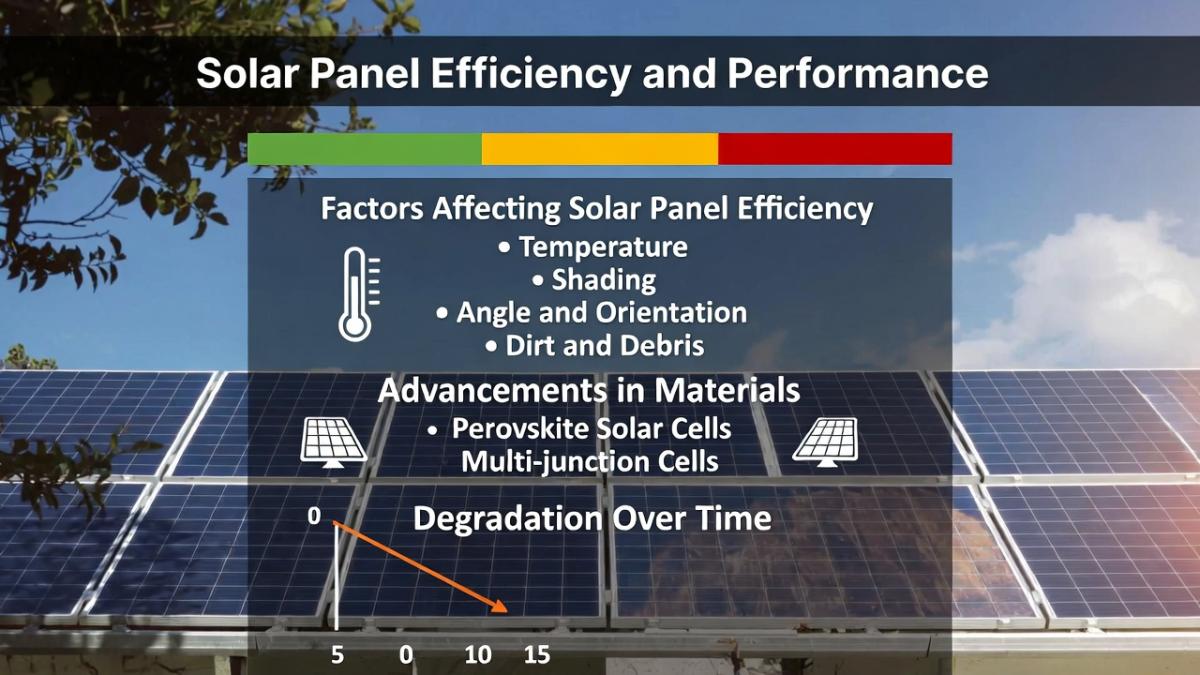
Efficiency doesn't exist in a vacuum. A panel rated at 21% doesn't deliver 21% of solar energy every day — it delivers that under standard test conditions (STC), which means 25°C temperature, 1,000 watts per square meter of irradiance, and a specific light spectrum. Real-world conditions diverge from this constantly.
Temperature: Silicon's Inconvenient Relationship with Heat
Here's an irony that surprises most people: solar panels perform worse when it's hot. Silicon solar cells lose roughly 0.3–0.5% of their rated efficiency for every degree Celsius above 25°C. A panel sitting on a black roof on a summer afternoon in Phoenix, Arizona may reach 65°C or higher. That's a 40°C rise above STC, which translates to a 12–20% performance loss just from temperature.
This is called the temperature coefficient, and it's one of the first things a savvy installer checks in a panel's datasheet. Lower temperature coefficients mean the panel handles heat better. Some thin-film technologies, like cadmium telluride (CdTe), have better temperature coefficients than standard silicon — one of the ways they remain competitive despite lower peak efficiency ratings.
Installers in warm climates often prioritize panels with low temperature coefficients over raw efficiency numbers. A panel rated at 19% efficiency with a temperature coefficient of -0.28%/°C will outperform a 21% panel with a -0.45%/°C coefficient across a hot summer.
Shading: The Weak Link Problem
Solar panels connected in series behave a little like old Christmas lights: shade one cell, and it restricts the entire string. A single leaf, bird dropping, or corner shadow can disproportionately reduce output from an entire panel or row of panels.
This is the problem that microinverters and DC power optimizers were designed to solve. By converting power at the individual panel level rather than at a central inverter, these devices allow unshaded panels to continue performing independently. The efficiency gain from these technologies isn't about the panel itself — it's about minimizing losses that the panel design can't address.
Orientation, Tilt, and Soiling
The angle and direction a panel faces determines how much sunlight it intercepts over a year. In the Northern Hemisphere, south-facing panels at a tilt roughly equal to local latitude maximize annual energy production. But "maximum" is a moving target — the optimal tilt for summer production differs from winter, and flat installations on commercial rooftops sacrifice some performance for structural simplicity and cost.
Soiling — the accumulation of dust, pollen, pollution, and bird droppings on panel surfaces — is an underappreciated efficiency killer, particularly in arid regions. Studies in the Middle East have shown soiling losses exceeding 6% per month for uncleaned panels. Utilities operating large desert installations budget significant resources for panel cleaning.
Spectrum and Light Quality
Standard efficiency ratings assume a specific solar spectrum (the AM1.5 spectrum, corresponding to sunlight passing through 1.5 atmospheres of air). In reality, the spectrum shifts throughout the day and across seasons. Overcast conditions remove ultraviolet wavelengths; morning and evening light is redder. Different cell technologies respond differently to these spectral shifts — thin-film technologies sometimes perform better under diffuse or low-light conditions, making them attractive for cloudy climates despite lower peak efficiencies.
Silicon's Decades of Dominance
Silicon remains the backbone of the solar industry for reasons that go beyond physics. It's the second most abundant element in the Earth's crust, it's non-toxic, and the global electronics industry spent 70 years developing sophisticated techniques to manufacture it with extraordinary purity and precision.
The dominant technology today is monocrystalline silicon, made from a single continuous crystal grown from molten silicon. Monocrystalline cells are uniform in structure, allowing electrons to move efficiently without encountering grain boundaries that scatter and lose energy. They achieve the highest efficiencies in standard commercial panels.
Polycrystalline silicon — made by casting molten silicon and allowing it to solidify into a lattice of many small crystals — was once cheaper to manufacture and dominated the market in the 2000s and 2010s. Its efficiency is slightly lower because those grain boundaries do impede electron flow. As manufacturing costs for monocrystalline panels have collapsed, polycrystalline has steadily lost market share.
The most significant silicon innovation of the past decade is the PERC cell (Passivated Emitter and Rear Contact). Standard silicon cells lose energy through recombination — electrons freed by photons finding their way back to electron "holes" before reaching the circuit. PERC cells add a passivation layer on the rear of the cell that reflects unabsorbed light back through the silicon for a second pass and reduces recombination at the rear surface. This innovation added roughly 1–2 percentage points of efficiency at modest manufacturing cost, and PERC technology now dominates new panel production globally.
The frontier beyond PERC is TOPCon (Tunnel Oxide Passivated Contact) and HJT (Heterojunction Technology) cells. These technologies push passivation further, achieving efficiencies in the 24–26% range in commercial production. HJT cells are particularly notable for their low temperature coefficients and high bifacial gains — they can generate power from light reflected off the ground onto their rear surface.
The Perovskite Promise — and Its Problems
Few developments in solar energy have generated as much scientific excitement — or as much careful qualification — as perovskite solar cells. The name refers not to the material itself but to its crystal structure, shared by calcium titanate, the mineral first described by Russian mineralogist Lev Perovski in the 19th century.
The specific perovskite compounds used in solar cells are typically lead-halide structures with the formula ABX₃, where A is usually methylammonium or cesium, B is lead, and X is a halide like iodine or bromine. The excitement around these materials stems from a confluence of extraordinary properties.
The efficiency trajectory is historically unprecedented. When perovskite solar cells first appeared in the scientific literature in 2009, they achieved around 3.8% efficiency. By 2023, certified laboratory cells had surpassed 26%, overtaking the best single-junction silicon cells. This rate of improvement — from 3.8% to 26% in roughly 14 years — has no parallel in the history of photovoltaics. Silicon took 40 years to travel a similar distance.
The fabrication potential is transformative. Silicon cells require energy-intensive, high-temperature processing to purify and crystallize the material. Perovskite films can be deposited from solution at low temperatures, potentially using printing or coating processes compatible with roll-to-roll manufacturing — the same basic approach used to print newspapers. In theory, this could make solar panels dramatically cheaper to produce.
The bandgap tunability opens doors that silicon cannot. Perovskites can be chemically tuned to absorb different parts of the solar spectrum by adjusting their composition. This is the key to why the most exciting near-term application isn't standalone perovskite panels — it's perovskite-silicon tandem cells.
The Tandem Strategy
A single-junction cell can only efficiently convert photons within a narrow energy range. Photons too energetic lose their surplus energy as heat; photons too weak pass through. A tandem cell stacks two semiconductor layers with different bandgaps: the top layer captures high-energy photons and lets lower-energy ones pass through to the bottom layer, which absorbs them. This approach breaks the Shockley-Queisser limit for single junctions.
Perovskite, with its tunable bandgap, is an ideal partner for silicon. The top perovskite layer absorbs high-energy visible light while the silicon beneath captures near-infrared photons. In 2023, several research groups and startups reported perovskite-silicon tandem cells exceeding 33% efficiency in laboratory conditions. Longi, the world's largest solar manufacturer, announced a 33.9% efficient perovskite-silicon tandem in 2023.
This matters enormously for the economics of solar energy. Higher efficiency means fewer panels needed for the same power output, which means less land, fewer mounting structures, less wiring, and lower installation labor — all the so-called "balance of system" costs that often exceed the panel cost itself.
The Obstacles Are Real and Unresolved
Perovskite research would be irresponsible to discuss without confronting its genuine challenges.
Stability is the central problem. Perovskite cells degrade rapidly when exposed to moisture, oxygen, heat, and ultraviolet light — essentially, every condition present outdoors. Early perovskite cells lost significant efficiency within hours of exposure to air. Years of research have dramatically improved stability, but commercial silicon panels are warranted to maintain at least 80% of their original output for 25–30 years. No perovskite product approaches this standard today. The fastest-degrading component is often the interfaces between layers, which can change chemically over time in ways that aren't fully understood or controlled.
Lead toxicity presents regulatory and environmental questions. Most high-efficiency perovskite cells contain lead. While the amount per panel is small, the presence of a toxic heavy metal in widely-deployed consumer products raises legitimate concerns about manufacturing waste and end-of-life disposal. Researchers are actively developing tin-based or other lead-free perovskites, but these currently underperform their lead-containing counterparts significantly.
Scaling from lab to factory is non-trivial. A laboratory cell is a few square centimeters. A commercial solar panel is 1.7 square meters. The coating and printing processes that work beautifully at small scale often produce defects and non-uniformities at large areas, dragging efficiency down closer to silicon levels. Several companies — Oxford PV, Saule Technologies, Tandem PV — are working to bridge this gap, but commercial perovskite products remain limited.
The realistic near-term expectation: perovskite-silicon tandem panels will reach commercial production in meaningful volumes sometime in the late 2020s, initially at premium prices for applications where high efficiency justifies cost. Full displacement of standard silicon panels is a story for the 2030s and beyond — if stability challenges yield to continued material science progress.
Beyond Perovskite — Other Frontiers
While perovskite dominates solar research headlines, other technologies continue to advance.
Organic photovoltaics (OPV) use carbon-based semiconductor molecules that can be printed onto flexible substrates. They've recently crossed 18% efficiency in single-junction form and offer the prospect of truly lightweight, flexible, building-integrated solar — think solar-generating windows or textiles. Their stability lags even further behind perovskites.
Concentrator photovoltaics (CPV) use lenses or mirrors to focus sunlight onto tiny, extremely high-efficiency cells made from expensive III-V semiconductor compounds like gallium arsenide. Some CPV cells have exceeded 47% efficiency — but only under concentrated light and direct normal irradiance, making them suitable only for specific desert environments with high direct sunlight. Their cost and complexity have limited deployment.
Quantum dot solar cells use nanometer-scale semiconductor particles whose electronic properties can be tuned by controlling their size. They've reached 18% efficiency in lab settings and theoretically could exceed the Shockley-Queisser limit through processes like multiple exciton generation. This remains firmly research territory.
The Long Game — Understanding Solar Degradation
The efficiency a panel achieves on day one is not the efficiency it will achieve in year 20. All solar panels degrade over time, and understanding how and why they degrade is critical to calculating the true lifetime value of a solar installation.
The industry standard metric is the annual degradation rate, typically expressed as a percentage loss per year. For premium crystalline silicon panels, this rate is roughly 0.5% per year. That means after 25 years, the panel delivers approximately 88% of its original output. Many manufacturers warranty exactly this: 80% output after 25 or 30 years.
Less reputable panels can degrade at 0.7–1.0% annually, dropping to 75% or below by year 25. Over the lifetime of a system, these differences compound into substantial real-world energy differences.
Light-Induced Degradation (LID)
In the first hours and days of operation, most silicon solar panels experience light-induced degradation — a rapid but typically limited initial efficiency loss caused by the formation of boron-oxygen defects in the silicon when it's exposed to light. Standard monocrystalline PERC panels can lose 1–3% of output from LID in their first day of sunlight. This is now so well understood that many manufacturers pre-treat panels with light soaking before shipping to trigger and stabilize LID before installation.
A more recent and more problematic phenomenon is light and elevated temperature-induced degradation (LeTID), which occurs over months and years of operation rather than hours. LeTID can cause losses of several percent and is triggered by a combination of illumination and heat — precisely the conditions a panel experiences every summer day. The mechanisms of LeTID are still being actively researched, and mitigation strategies are being incorporated into manufacturing processes with varying degrees of success.
Potential-Induced Degradation (PID)
In larger solar systems where panels operate at high voltages relative to their frames, potential-induced degradation can cause dramatic efficiency losses — sometimes exceeding 30% — through ion migration and leakage currents within the panel structure. PID is highly dependent on system voltage, module design, humidity, and temperature, making it a particular concern in hot, humid climates and large utility-scale installations. Anti-PID treatments and system design choices can substantially mitigate the problem.
Delamination and Physical Degradation
Solar panels are laminated structures: silicon cells encapsulated in ethylene-vinyl acetate (EVA) polymer, sandwiched between a glass front sheet and a polymer or glass back sheet, all sealed in an aluminum frame. Over decades of thermal cycling, UV exposure, and mechanical stress from wind and snow loads, the polymer layers can yellow, crack, or delaminate from the glass or cells. Delamination allows moisture ingress, accelerating electrochemical corrosion and cell damage.
Snail trails — dark brown discolorations in the EVA that trace the patterns of microscopic silver paste cracks in the cells beneath — are a cosmetic manifestation of cell cracking that can indicate underlying electrical degradation. Hot spots form when damaged or shaded cells receive reverse current, heating to temperatures that can permanently damage the cell and surrounding materials; bypass diodes in junction boxes are designed to prevent the worst hot-spot scenarios.
Inverter and Balance-of-System Degradation
The panel itself often outlasts its supporting electronics. String inverters — the central units that convert DC from panels to AC for home or grid use — typically carry warranties of only 10–15 years. A 25-year solar system will almost certainly require at least one inverter replacement, a cost that financial models must account for honestly. Microinverters and power optimizers generally offer better warranty terms (25 years for some microinverter brands) but at higher upfront cost.
Reading Between the Lines on Efficiency Claims
The solar industry has not always been transparent with consumers. Flash test conditions — the standard conditions under which efficiency is measured — are idealized. Real-world performance is lower, and by how much depends on location, installation quality, and the specific characteristics of the panel.
Performance ratio — the ratio of actual energy produced to the theoretical maximum given the local solar resource — is a more honest metric for system performance. Well-designed, well-installed systems in favorable climates often achieve performance ratios of 75–85%.
Bifacial panels, which have transparent or semi-transparent rear surfaces and can capture reflected light from beneath, are marketed with "bifacial gain" figures that assume specific albedo conditions (ground reflectivity). A bifacial gain of 10% sounds compelling on a white rooftop or snowy landscape; it's closer to 2–4% on dark ground. The industry has sometimes been loose with these claims.
The most reliable performance data comes from independent testing organizations — PV Evolution Labs (PVEL), DNV, UL — that conduct real-world outdoor testing over multiple years. Their reliability scorecards and degradation rate measurements, while not always available to consumers, are taken seriously by utility-scale buyers and project financiers.
Where the Industry Goes From Here
The trajectory of solar efficiency improvements follows a pattern familiar from semiconductor manufacturing: steep early gains, then slower incremental progress as the technology matures, punctuated by occasional step-changes when a new technology platform crosses the commercialization threshold.
Silicon is approaching its practical commercial ceiling. The next several years will see continued refinement of TOPCon and HJT technology, modest efficiency gains, and relentless cost reduction through manufacturing scale. The bigger efficiency story of the 2030s will be written by tandem cells — most likely perovskite-silicon, possibly all-perovskite or perovskite-III/V for specialized applications.
The question of degradation is, if anything, more important than raw efficiency. A 25% efficient panel that degrades at 0.8% per year delivers less lifetime energy than a 21% panel degrading at 0.3% per year. The industry's collective push toward better encapsulation materials, improved cell architectures that resist LID and LeTID, and more rigorous manufacturing quality control is ultimately about extending the financial viability of solar assets over decades-long investment horizons.
What's easy to lose sight of amid the technical details is the broader arc. Solar electricity is now, in most of the world, the cheapest source of new electricity generation in human history. The efficiency of panels already deployed on rooftops and in fields across the planet is good enough to power a meaningful share of global electricity demand. The advances in materials science and manufacturing that will characterize the next decade aren't solving a crisis — they're extending an advantage, pressing down costs and expanding the applications where solar makes overwhelming economic sense.
The sun has been waiting 4.6 billion years for us to figure out how to catch its energy efficiently. By any reasonable measure, we're finally getting pretty good at it.
This editorial covers developments current as of early 2026. Technology developments in solar photovoltaics move quickly; specific efficiency records and commercial availability of emerging technologies may have advanced since publication.