Foldable solar panels are a game-changer for anyone who loves to adventure off the grid. They’re lightweight, easy to carry, and perfect for camping, hiking, or road trips. With their compact design, you can set them up in no time and enjoy clean, renewable energy wherever you go!
Foldable Solar Panels
Get portable power anytime, anywhere with these easy-to-use foldable solar panels
Product List
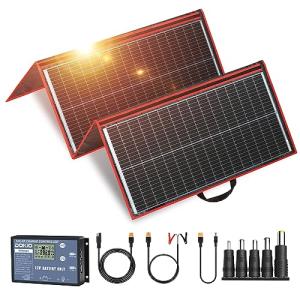
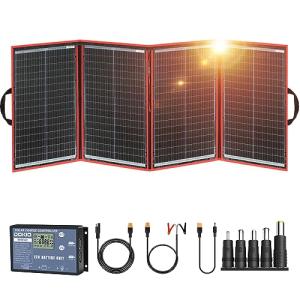
DOKIO 200W Portable Solar Charger
Product Review Score
4.48 out of 5 stars
11 reviews$123.28 $104.79
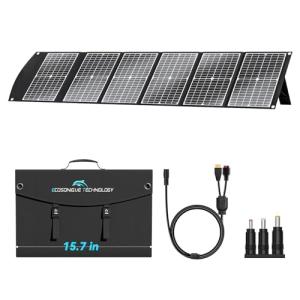
There's something quietly remarkable about unfolding a thin, lightweight panel in the middle of nowhere and watching your devices come back to life. Foldable solar panels have changed the way we think about energy — not as something tethered to a wall or dependent on infrastructure, but as something you carry with you, deploy in minutes, and pack away just as fast.
Whether you're camping deep in the backcountry, sailing offshore, overlanding through remote terrain, or simply preparing your home for power outages, foldable solar panels offer a practical, durable, and surprisingly powerful answer to one of modern life's most persistent questions: where do I charge this?
What Are Foldable Solar Panels?
Foldable solar panels are portable photovoltaic (PV) charging systems built around a hinged or multi-panel design that allows them to fold flat for storage and transport, then open up to maximize surface area — and therefore power generation — when in use.
Unlike rigid rooftop panels or fixed installations, foldable panels are engineered specifically for mobility. They're lightweight enough to clip onto a backpack, slip into the back of a truck, or stow in a boat locker. When the sun comes out, you unfold them, angle them toward the light, and plug in your devices or portable power station.
They come in a wide range of wattages — from compact 10W or 20W panels suited for phone charging on day hikes, all the way up to 200W or even 400W multi-panel arrays designed to keep a refrigerator running off-grid or top off a large capacity battery bank in a van or RV.
How Do Foldable Solar Panels Work?
At their core, foldable solar panels work exactly like any other solar panel: photovoltaic cells convert sunlight into direct current (DC) electricity. What makes them distinct is the way they're packaged and delivered to the end user.
Most foldable panels use one of three cell technologies:
Monocrystalline silicon is the gold standard. Cells are cut from a single crystal of silicon, giving them a uniform structure that converts sunlight into electricity at efficiencies typically ranging from 21% to 24%. They perform better in low-light and cloudy conditions than other technologies, making them the most popular choice for premium foldable panels.
Polycrystalline silicon uses multiple crystal fragments fused together. They're less expensive to manufacture and only marginally less efficient — typically 15% to 17% — which makes them a solid choice for budget-conscious buyers who don't need top-end performance.
Thin-film technology, including CIGS (copper indium gallium selenide), offers the greatest flexibility and the lowest weight per watt. Efficiency is lower — often 10% to 13% — but thin-film panels can curve and flex in ways rigid crystalline panels cannot, making them useful for specialized applications like curved surfaces or ultralight backpacking kits.
The output of a foldable panel flows through built-in cables and connectors — most commonly USB-A, USB-C, DC barrel jacks, and Anderson Powerpole or MC4 connectors — to power devices directly or charge a portable power station, battery bank, or 12V vehicle system.
Why Choose a Foldable Solar Panel Over Other Options?
People often wonder whether a foldable panel is really worth it when they could just use a wall charger, a car charger, or a compact rigid panel. The honest answer depends on how you live and where you spend your time — but for a surprisingly large number of people, foldable panels win on almost every practical dimension.
Portability is the obvious one. A 100W foldable panel typically weighs between 4 and 7 pounds and collapses to the size of a laptop bag. That same 100W in a rigid aluminum-framed panel would weigh three or four times as much and couldn't be carried on your back at all.
Setup is fast. There's no mounting hardware, no roof rails, no wiring harness. You unfold the panel, find a sunny spot, prop it up using the integrated kickstand (included on virtually all quality models), and plug in your device. From folded to charging in under two minutes.
They don't require a permanent installation. Renters, travelers, and people who move frequently between locations love foldable panels precisely because they own the energy solution outright, without modifying any property. Take it with you. Use it wherever you are.
They're genuinely durable. The best foldable panels use high-density nylon or canvas fabric for the outer casing, tempered glass or EVA laminate over the cells themselves, and reinforced stitching at the stress points. Corner guards, waterproof zippers, and IP67-rated junction boxes are standard on quality models. These are products designed to get rained on, tossed in a truck bed, and used hard for years.
Choosing the Right Wattage for Your Needs
Wattage is the number everyone focuses on first, and it matters — but it's not the only thing that matters. Here's a practical way to think about sizing:
20W to 40W panels are ideal for day hikers, travelers, and anyone who primarily needs to keep a phone, GPS unit, headlamp battery, or small Bluetooth speaker charged. At 20W under direct sun, you're looking at roughly enough power to fully charge a modern smartphone in one to two hours. These panels are the lightest and most compact in the category.
60W to 100W panels hit the sweet spot for most overlanders, van campers, kayakers, and boat users. A 100W panel can meaningfully contribute to a 100Ah lithium battery system or keep a portable power station topped off during the day while you run lights, fans, and small appliances in the evening. This is the range where quality monocrystalline efficiency really pays off.
120W to 200W panels are built for serious off-grid setups: extended camping trips, remote work locations, emergency preparedness systems, or anyone who needs to run a CPAP machine, a 12V fridge, or a laptop throughout the day. These panels are heavier and bulkier when folded, but they deliver genuinely significant energy — enough to make a real difference to daily power budgets.
200W and above begins to overlap with semi-permanent or vehicle-mounted solar solutions. Multi-panel foldable arrays in this range are popular among RV users who want a portable supplement to their rooftop panels, and among homesteaders or off-grid cabin owners who want flexible supplementary power without more roof penetrations.
What to Look for When Shopping
The foldable solar panel market has expanded enormously in recent years, which is great for consumers — but it also means there's a wide range of quality on offer. Here's what separates a reliable, long-lasting panel from one that disappoints after a season:
Cell quality and efficiency rating. Look for panels that specify their cell efficiency — ideally 21% or higher for monocrystalline. Be skeptical of panels that only list total panel output without specifying cell efficiency, as this can obscure the use of lower-grade cells.
ETFE vs. PET lamination. ETFE (ethylene tetrafluoroethylene) is a premium surface material that's more scratch-resistant, more transparent, and longer-lasting than the cheaper PET (polyethylene terephthalate) laminate used on budget panels. ETFE panels typically carry a longer warranty and hold their efficiency better over time.
Connector and cable quality. The output cables and connectors on a foldable panel take real abuse — they're pulled, coiled, rained on, and stepped on. Look for thick, flexible cables rated for outdoor use, and connectors that fit your power station or battery system without requiring adapters.
Integrated kickstand. This seems minor until you're trying to prop a panel up in the field using rocks and sticks. A solid, adjustable kickstand that folds flat when not in use is a genuine quality-of-life feature.
Weight and folded dimensions. These matter a lot if you're carrying the panel. A 100W panel that weighs 7 pounds and folds to 21 x 14 inches is very packable. One that weighs 11 pounds and folds to 24 x 18 inches is more of a car-camping item. Know which you need before buying.
Warranty and manufacturer support. Quality brands back their panels with 1- to 3-year product warranties and 25-year power output guarantees. If a brand doesn't publish clear warranty terms, that tells you something.
Caring for Your Foldable Solar Panel
Foldable panels are low-maintenance by design, but a few habits will keep yours performing well for years.
Keep the surface clean. Dust, pollen, bird droppings, and salt spray all reduce light transmission and lower output. A soft cloth dampened with fresh water is all you need — avoid abrasive cleaners or pressure washing, especially on ETFE surfaces.
Store it folded and dry. Most quality panels shed rain well, but don't leave them wet and folded up for extended periods. If you've used yours in rain or condensation, unfold it briefly to air-dry before packing it away.
Avoid sharp objects on the cell surface. The cells themselves are surprisingly robust, but a sharp edge — a tent stake, a tool, a key — can scratch the laminate and eventually allow moisture intrusion.
Angle toward the sun. Even a modest improvement in panel angle relative to direct sunlight can increase output by 20% to 40%. Most panels include a built-in kickstand that allows you to adjust the tilt angle; use it. Chasing the sun throughout the day makes a real difference on shorter winter days or overcast conditions.
The Bigger Picture — Why Portable Solar Matters
There's an energy independence story underneath the practical specs and buying advice. Foldable solar panels represent something genuinely new: the ability for an individual person to generate meaningful amounts of clean electricity, wherever they happen to be, without infrastructure, without fuel, and without ongoing cost.
That matters for the weekend adventurer who wants to keep their phone charged on a thru-hike. It matters for the family who wants a reliable backup power solution when the grid goes down. It matters for the remote worker who has discovered that their best thinking happens somewhere without a power outlet nearby. And it matters in a broader sense — every kilowatt-hour generated by a portable panel is one that didn't come from a fossil fuel.
The technology has matured rapidly. Modern foldable panels are more efficient, more durable, lighter, and more affordable than they were even five years ago. The category has moved well past early-adopter territory into mainstream utility — and for a growing number of people, a foldable solar panel isn't a novelty. It's a tool they reach for as naturally as a water filter or a headlamp.
Find the Right Foldable Solar Panel for You
Whether you're a weekend warrior, a full-time traveler, or someone building a resilient home power setup, there's a foldable solar panel sized and priced for your situation. Browse by wattage to match your power needs, compare cell technologies to match your weight and budget priorities, and look at the connector options to make sure your new panel will integrate seamlessly with the gear you already own.
The sun shows up every day. A foldable solar panel makes sure you're ready when it does.