Who Is the FlexSolar 60W Actually For?
Before getting into specs, it's worth being direct about the audience. The FlexSolar 60W is not a lightweight backpacking panel — it weighs around 6.4 lbs and unfolds to 33.8 × 28.1 inches. That's substantial. It's designed for people who are moving base camp, not ultralight thru-hikers counting every gram.
The ideal user profile looks something like this:
- Car campers and overlanders who need reliable charging at a fixed campsite or vehicle setup
- Van-life travelers who want a deployable panel that doesn't require a rooftop installation
- Emergency preparedness households building a kit that works when the grid doesn't
- Small power station owners with units under 300Wh who want a capable solar input source
- Festival-goers and weekend warriors who need phones, tablets, and gadgets topped up without hunting for outlets
If you're any of these people — or some combination — the FlexSolar 60W is worth your serious attention.
Key Specifications at a Glance
The FlexSolar 60W features three charging outputs: a QC3.0 USB-A port rated at up to 18W, a PD3.0 USB-C port rated at up to 40W, and a DC output delivering up to 60W at 20–28V — capable of directly powering small-to-medium solar generators under 300Wh, battery packs, iPads, and smartphones.
The panel folds to a compact laptop-sized form factor of 13.8 × 9.1 × 2.2 inches and weighs 6.4 lbs, unfolding across six panels to reach full size for solar harvesting.
The junction box integrates QC3.0 USB-A at up to 18W (5V/3A, 9V/2A, 12V/1.5A), PD3.0 USB-C at up to 45W (5V/3A, 9V/3A, 12V/3A, 15V/2.3A, 20V/2.3A), and a 19V/60W max DC output.
The panel carries an IP67 waterproof rating, and hanging hooks and carabiners allow it to be strapped to vehicles, tents, and other surfaces.
The Charging Ports — What Each One Is Actually Good For
This is where the FlexSolar 60W separates itself from cheaper single-port alternatives. Three distinct outputs serve three distinct use cases, and understanding how each one performs in practice matters a lot.
PD3.0 USB-C — The Port That Does the Heavy Lifting
The USB-C port is the headline act here. The USB-C port is rated for up to 60W output, and a MacBook recognized it as a 60W charger during testing — it also charges devices requiring less wattage, making it a versatile all-in-one option for phones, tablets, headphones, and laptops that use USB-C.
That's a genuinely impressive spec for a portable foldable panel in this price bracket. Many competitors cap their USB-C at 18W or 30W and call it PD-compatible. FlexSolar doesn't cut corners here, and it shows in real-world fast-charging performance with modern devices.
QC3.0 USB-A — The Universal Fallback
One of the USB-A ports is a QC3.0 port capable of outputting up to 18W to compatible devices, while both USB-A ports are rated for up to 15W output at their base specification.
This matters because QC3.0 remains the standard fast-charging protocol for a huge swath of Android devices, older iPhones, Bluetooth speakers, and portable lighting. Having it on board means you're not limited to slow 5W trickle charging for non-USB-C gear.
DC Output — The Power Station Connection
The DC output is the reason this panel attracts power station owners. The DC port delivers up to 60W at 20–28V and is capable of directly powering small-to-medium solar generators under 300Wh.
The package includes a 10-foot DC5521 cable and four different DC adapters, making it compatible with Goal Zero, Jackery, most Bluetti, and Rockpals power stations out of the box — the alligator clamps included allow connection to 12V batteries, though a solar charge controller must be purchased separately for that application.
One important note for buyers: some portable power stations carry a maximum input power limit, meaning even with the 60W panel operating in optimal sunlight, the power they receive won't exceed their station's maximum input — this is a limitation of the power station, not the panel itself.
Build Quality and Materials — Does IP67 Actually Mean Waterproof?
Waterproofing claims on budget solar panels are frequently overstated. The FlexSolar 60W earns some genuine credibility here, though with nuance worth understanding.
The panel layout is laminated with ETFE — the most durable panel material available, more resistant to abrasion and corrosion than PET panels — and the construction includes waterproof nylon fabric and a waterproof zip for added weather resistance.
The IP65 waterproofing means the panel is completely protected against dust and resistant to low-pressure water jets from any direction — leaving it out in light rain during camping use caused no functional damage in testing.
The newer model carries an upgraded IP67 rating on the panel itself, which represents full protection against temporary immersion. The junction box where the charging ports live is not rated to the same waterproof standard as the panel surface itself, so keeping the port area sheltered from direct rain is still recommended practice.
The surface layer uses E-film material with characteristics of high strength, good transparency, impermeability, and light weight, housing A+ monocrystalline silicon cells that efficiently convert solar energy to electricity.
The six-panel fold construction means there are stress points at each fold line, but the panel fabric is reinforced at these seams and shows no signs of degradation under normal outdoor use.
Real-World Performance — What to Expect in the Field
Here's where honesty matters most. Solar panel marketing always quotes peak lab output. The real world is cloudier, less perpendicular to the sun, and more complicated.
Power output varies with sunlight conditions — the panel can deliver 60W in direct sun but will produce approximately 30–40W on overcast days.
That's a significant real-world range, and it shapes how you should plan your charging strategy. On clear days, the DC output to a small power station will fill a 268Wh battery over a full day with repositioning as the sun moves. Cloudy days mean slower fills and more patience.
Real-world user experience confirms this — one reviewer paired the panel with a Bluetti EB3A and found it charged a 268Wh battery adequately over a camping weekend, though repositioning the panel to track the sun throughout the day was necessary to maintain optimal output.
The smart IC chip plays a meaningful role in maximizing what you do get. The built-in intelligent chip automatically identifies connected devices and adjusts output current to deliver the fastest possible charging speed, with an LED indicator light showing charging status — a red light indicates active charging.
For direct device charging — phones, tablets, earbuds — performance is excellent in good sunlight. A modern smartphone can go from 20% to full in under two hours in direct afternoon sun via the USB-C port.
Portability and Setup — Six Seconds to Solar
One of the FlexSolar 60W's strongest practical advantages is how quick and intuitive the setup process is. There are no additional components to connect, no apps to configure, no charge controllers to fiddle with for USB or power station charging.
Unfold the six panels, prop or hang them at an angle toward the sun, connect your device or power station, and the LED confirms charging has begun. That's genuinely the full setup process for most use cases.
The foldable PET design includes handles and eyelets that make it easy to carry, hang, or prop — and the integrated charging ports with LED status light make solar charging intuitive without any learning curve.
Hanging hooks and carabiners are included, allowing the panel to be strapped to vehicle exteriors, tent walls, backpacks, or any vertical surface to capture sun at the right angle without needing a dedicated stand.
The folded dimensions — approximately 13.8 × 9.1 × 2.2 inches — mean it fits into a large backpack, duffel, or vehicle storage compartment without dominating the space. The carry handle integrated into the folded panel makes one-handed transport completely natural.
What's in the Box — Accessories That Actually Matter
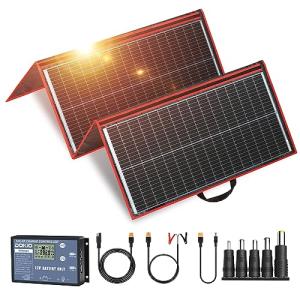
The package includes one 60W portable solar panel, a 4-in-1 DC connector set (XT60, DC5521, DC7909, Anderson), and a user manual.
The 10-foot DC cable is a particularly welcome inclusion, giving enough length to position the panel optimally in the sun while the power station remains in shade or inside a vehicle — a detail that smaller budget panels often skip entirely.
The four DC connector types cover the most popular power station brands without additional purchases, which is a practical decision that reduces frustration for new buyers.
One gap worth noting: a solar charge controller is not included, so buyers intending to charge 12V lead-acid batteries via the alligator clamp connection must purchase one separately to avoid overcharge risk. For power station and direct device charging, no controller is needed — this only applies to 12V battery bank applications.
FlexSolar 60W vs. Competing Panels
| Feature | FlexSolar 60W (B0D6B5X2N9) | Jackery SolarSaga 60W | BigBlue 28W | Anker 625 Solar Panel (100W) | SOKIOVOLA 60W |
|---|---|---|---|---|---|
| Wattage | 60W | 60W | 28W | 100W | 60W |
| USB-C Output | PD3.0 (40W max) | 18W | 18W | PD3.0 (30W) | PD3.0 |
| USB-A Output | QC3.0 (18W) | USB-A 5V | QC3.0 | USB-A | QC3.0 |
| DC Output | Yes (60W, 20-28V) | Yes (Jackery proprietary) | No | Yes | Yes |
| Waterproof Rating | IP67 | IP65 | IPX4 | IP67 | IP68 |
| Weight | 6.4 lbs | 6.6 lbs | 1.1 lbs | 10.7 lbs | ~5.9 lbs |
| Folded Size | 13.8×9.1×2.2 in | 12×9×1 in | 6.3×5.5 in | 24×11×1.5 in | ~13×9 in |
| Cell Type | Monocrystalline | Monocrystalline | Monocrystalline | Monocrystalline | Monocrystalline |
| Smart IC Chip | Yes | No | Yes | Yes | Yes |
| Accessories Included | DC cable + 4 adapters + carabiners | Jackery-only cable | USB cables only | USB-C cable only | DC cable + adapters |
| Power Station Compat. | Universal (multi-connector) | Jackery only | No DC port | Universal | Universal |
| Best For | Camp + van + emergency | Jackery ecosystem | Ultralight hiking | High-demand base camp | Budget buyers |
The table tells a clear story. The FlexSolar 60W punches well above its price point in terms of port diversity and accessory inclusion. The Jackery SolarSaga is a natural competitor but locks you into a proprietary ecosystem. The Anker 100W offers more raw power at more size and cost. For the sweet spot of portability, charging versatility, and universal compatibility, the FlexSolar 60W is genuinely hard to beat.
Pros and Cons — The Honest Breakdown
What Works Well
Multiple fast-charging protocols in one device. Having PD3.0, QC3.0, and DC simultaneously available means one panel covers phones, tablets, laptops, and power stations without compromise or adapters.
Genuinely portable for its wattage class. At 60W and 6.4 lbs, this sits at a reasonable weight-to-output ratio. Panels that deliver more wattage typically weigh and cost considerably more.
Broad power station compatibility. The included DC adapter set works with Goal Zero, Jackery, Bluetti, Rockpals, and similar brands without hunting for proprietary cables.
Solid build for outdoor conditions. The ETFE lamination, IP67 rating on the panel surface, and reinforced waterproof zip give genuine confidence in light rain and dusty conditions.
Smart IC chip prevents overcharging. The automatic device detection and output adjustment is a real safety feature, not just a marketing claim.
Where It Falls Short
DC port requires careful power station verification. Buyers need to check their power station's maximum input wattage before purchase to avoid disappointment. A 60W panel into a station that accepts only 45W maximum input will cap at 45W regardless.
No charge controller for 12V battery applications. For anyone wanting to charge lead-acid 12V batteries, this is an additional purchase. It's the right engineering decision for safety reasons, but it's a gap to be aware of.
Performance depends heavily on sun position. Like all solar panels, output drops significantly in partial shade or when the panel angle isn't optimized. Repositioning throughout the day is necessary for best results — this is solar physics, not a product flaw, but new buyers should be prepared for it.
Not ideal for serious hiking. At 6.4 lbs, it's a base camp panel, not a trail panel. Ultralight hikers have better options at lower wattages.
Emergency Preparedness — A Use Case Worth Taking Seriously
One conversation that doesn't get enough airtime in solar panel reviews is the emergency preparedness angle, and it deserves more attention than a footnote.
The FlexSolar 60W is suited to earthquake, storm, and grid-outage scenarios — its ability to charge phones and small power stations makes it a practical component of any household emergency kit.
A 60W panel paired with a 300Wh power station gives a household enough cycling capacity to keep communication devices alive, run LED lighting, and power small medical devices through extended outages. Unlike gasoline generators, there's no fuel storage required, no carbon monoxide risk, and no noise. The panel folds away in a closet until needed and deploys in under a minute.
For anyone in hurricane zones, wildfire-adjacent regions, or areas with aging grid infrastructure, this isn't a camping luxury — it's genuinely practical preparedness hardware.
FlexSolar as a Brand — Context Matters
FlexSolar was founded in 2009 and has focused on developing lightweight, portable, and innovative energy products for over a decade, operating as a brand integrating production, research, and development with the stated goal of providing green energy everywhere.
That history matters when evaluating a product like this. The 60W panel isn't a white-label commodity with a sticker applied — it reflects genuine iterative development across multiple generations of the product line.
FlexSolar backs its 60W panel with a 30-day money-back guarantee and a 2-year warranty, which represents meaningful post-purchase confidence for buyers spending in this category.
Pairing Recommendations — Getting the Most From Your FlexSolar 60W
The panel performs best when paired deliberately. Here's what works well in practice:
For car camping: Lay the panel across the hood or roof during the day while camp is set up. The DC output into a Jackery 240 or Bluetti EB3A will keep that station topped up continuously in good sun.
For van life: Mount with the included carabiners on a south-facing window, awning, or roof rack attachment. The 10-foot DC cable gives enough reach to keep your power station inside the van while the panel works outside.
For emergency kit: Store folded with a small 300Wh station. Drill — deploy panel, connect DC cable, confirm LED is active — once a month to stay ready. The smart IC chip ensures safe charging without supervision.
For direct device charging: The USB-C PD port is the go-to for laptops and tablets. The QC3.0 USB-A handles older Android phones and accessories efficiently. Running both simultaneously is possible but splits available wattage.
Is the FlexSolar 60W Worth Buying in 2026?
The portable solar panel market has become genuinely competitive, and that's good news for buyers. The FlexSolar 60W earns its place near the top of the 60W category not because it's flashy or because the spec sheet is exaggerated, but because it solves real problems practically and without unnecessary limitations.
The combination of PD3.0 USB-C, QC3.0 USB-A, and a universal DC output that connects to most power stations out of the box is rare at this price point. The IP67 panel waterproofing gives genuine outdoor confidence. The included accessory set is better than most competitors bother with. And the smart IC charging protection means you're not nursing your devices through risky trickle charging.
It isn't perfect — the junction box isn't rated to the same waterproof standard as the panel, the weight rules it out for true ultralight use, and you'll need to track the sun more than first-time solar users expect. These are real limitations, not dealbreakers.
For campers, van-lifers, emergency preparedness households, and small power station owners who want a capable, portable, and genuinely versatile solar charger that doesn't require a separate ecosystem to function, the FlexSolar 60W is one of the most sensible buys in its class.
👉 Get the FlexSolar 60W on Amazon — check current price and availability here