There's a certain kind of freedom that comes with cutting the cord — not the cable subscription, but the one tethering you to the electrical grid. Whether you're parked at a remote campsite, riding out a blackout at home, or living the full-time RV life somewhere between nowhere and spectacular, portable solar power has gone from novelty to necessity. The question was never really whether to go solar — it was always which panel is actually worth your money.
The EBL 200W Portable Solar Panel (model B0GCDCQ895) makes a strong case for itself. It's a panel that has been quietly earning a reputation among outdoor enthusiasts, van-lifers, marine adventurers, and emergency-prep households alike — and after a thorough look at what it offers, the reasons become clear.
The Efficiency Argument: Why Monocrystalline Still Wins
Not all solar panels are created equal. The type of silicon cell inside a panel largely determines how much energy it can wring from the sun, and the EBL 200W doesn't cut corners here. It employs 6-layer ETFE lamination technology to integrate monocrystalline silicon solar cells, delivering enhanced heat and chemical corrosion resistance, with up to 97% light transmittance and a conversion efficiency of up to 23.5%.
That 23.5% efficiency figure matters more than it might initially sound. Traditional polycrystalline panels typically offer a conversion rate of only 17%, making this solar panel significantly more efficient than standard alternatives. In practical terms, that gap in efficiency translates directly to faster charging, better performance on overcast days, and more power delivered per square foot of panel surface.
The panel also performs well in low-light conditions, surpassing the performance and stability of similarly-rated polycrystalline solar panels, and is designed with an auto-optimization feature that automatically reconnects when sunlight returns after a charging interruption. That last detail is more useful than it sounds — a passing cloud or shifting shade won't leave your charging session stalled. The panel recovers on its own.
Built for the Elements: Weatherproofing That Earns Its Rating
Portable gear lives and dies by its durability. A solar panel that can't handle a sudden rainstorm or the harsh UV exposure of a full summer is a liability, not an asset. EBL addressed this directly in the design of the 200W panel.
This solar panel combines an upgraded PET lamination surface with a rugged 840D Oxford fabric back for enhanced durability, heat resistance, and dust protection. With a robust ETFE front layer and IP65 waterproof rating, it withstands rain, sun, and harsh outdoor elements.
The IP65 rating means the panel can handle water jets from any direction — not just light drizzle, but real rainfall during a camping trip. Its surface does not crack or peel, and dust can be wiped off with ease, meaning more power all the time and less maintenance required. For anyone who has dealt with degraded panels after a season or two of outdoor use, that build quality is genuinely reassuring.
Marine applications, in particular, benefit from this kind of construction. Salt air and sea spray are brutal on equipment, and a panel that can hold up on a boat deck while maintaining charging performance has cleared a meaningful bar.
Portability Without Compromise
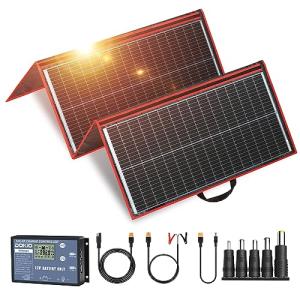
The word "portable" gets thrown around liberally in product descriptions, so it's worth examining what it actually means in this case. Designed for portability, this 200W solar panel features a foldable construction with a built-in zippered accessory pocket for cable management and a non-slip rubber handle. When folded, it measures just 23.11 × 22.76 × 1.4 inches and weighs only 17.94 lbs, folding down to a quarter of its unfolded size.
Under 18 pounds for a 200W panel is a respectable weight-to-power ratio. Panels in this wattage class used to require rigid frames and permanent mounts — the kind of infrastructure that made true portability impossible. The foldable form factor changes that equation entirely.
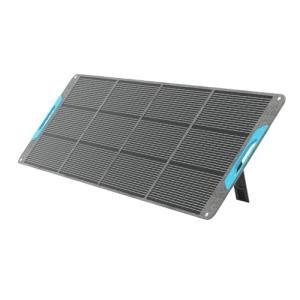
The panel's adjustable kickstand allows you to angle it for optimal sun exposure, a design that improves solar capture by up to 25% compared to panels laid flat on the ground. Getting the angle right isn't just about squeezing out extra watts — it extends the effective charging window across more of the day, particularly in the morning and late afternoon when the sun sits lower on the horizon.
Setup takes seconds. Equipped with 4 kickstands, the solar charger can be securely placed on the ground. Setting up the foldable solar panel is quick and easy — within 5 seconds, you can adjust its angle to maximize sunlight absorption. For a panel that may be deployed and packed repeatedly over the course of a trip, that ease of setup is a genuine quality-of-life improvement.
Connectivity: Works With What You Already Own
One of the persistent frustrations with portable solar has been compatibility. Buy the wrong panel and you might find yourself with a power source that doesn't talk to your generator, battery bank, or charge controller. EBL anticipated this problem.
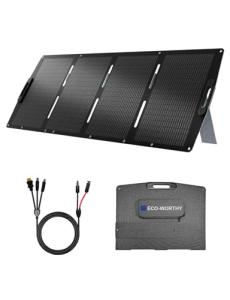
The panel includes an MC-4 to 4-in-1 charging cable with XT60, Anderson, DC7.9×0.9mm, and aviation connectors, ensuring compatibility with most solar generators. That four-in-one cable covers the majority of popular power station brands on the market.
The MC-4 interface can seamlessly connect via the included 10ft MC-4 cable to ensure compatibility with 95% of power stations available in the market. Additional outputs include a USB-A port (5V/3A), an orange USB-A (12V/1.5A), and a USB-C (20V/3A) that can charge phones, tablets, and laptops directly.
The panel fits Jackery and Bluetti stations and also works with Goal Zero gear. For users who have already invested in a particular ecosystem, this interoperability removes the anxiety of buying a panel that might not cooperate with existing equipment.
Safety Features That Matter in the Long Run
Charging electronics and batteries with solar introduces a set of risks — overcharging, short circuits, reverse current — that can damage equipment or, in worse cases, create safety hazards. The EBL 200W is built with overcharge, short-circuit, and reverse protection to keep devices and batteries safe, making it a dependable choice for long-term solar power solutions.
These protections aren't just marketing checkboxes. For anyone running the panel unattended — say, leaving it on a roof rack while hiking or mounted to an RV while parked — knowing the electronics are safeguarded is meaningful peace of mind. The panel handles its own current management so you don't have to babysit it.
Real-World Applications: Where This Panel Earns Its Keep
RV and Van Life — This is arguably where the EBL 200W shines most naturally. Whether powering an RV or preparing for an emergency, this rugged and reliable portable solar panel is designed for life on the go, capable of running larger appliances and electronics off-grid. Paired with a quality power station in the 1000–2000Wh range, a single 200W panel can meaningfully extend your off-grid stay between generator runs.
Marine Use — Boats present a unique challenge for portable power. Shore power isn't always available, fuel for generators is expensive, and the marine environment is punishing. The IP65 weatherproofing and durable ETFE surface make this panel a practical fit for keeping navigation electronics, lighting, and small appliances running aboard.
Camping and Overlanding — The foldable design and kickstand system make it straightforward to set up at a campsite with no tools required. Whether you need to run a portable fridge, charge camera gear, or keep communication devices powered in the backcountry, 200W provides a solid foundation.
Emergency Home Backup — Grid failures happen, and increasingly, they last longer than a few hours. When the grid goes down, the panel can run a radio, charge phones, keep lights on, and even boil water if needed — peace of mind in hard times. Stored flat when not in use, it takes up minimal space compared to a fuel-based generator while requiring no fuel storage or maintenance.
EBL 200W vs. The Competition: A Comparison
| Feature | EBL 200W (B0GCDCQ895) | Jackery SolarSaga 200W | Bluetti PV200 | Goal Zero Boulder 200 |
|---|---|---|---|---|
| Cell Type | Monocrystalline | Monocrystalline | Monocrystalline | Monocrystalline |
| Efficiency | Up to 23.5% | Up to 24.3% | Up to 23.4% | ~22% |
| Waterproof Rating | IP65 | IP67 | IP65 | IP67 |
| Weight | ~17.94 lbs | ~14.5 lbs | ~16.5 lbs | ~18 lbs |
| Foldable | Yes | Yes | Yes | No (rigid) |
| Kickstand Included | Yes (4 legs) | Yes (2 legs) | Yes | No |
| Output Connectors | MC-4 + 4-in-1 (XT60, Anderson, DC, Aviation) | DC8020 + USB-A + USB-C | MC4 + XT60 + Anderson | Anderson + USB-A |
| Brand Compatibility | 95%+ of market | Primarily Jackery | Primarily Bluetti | Primarily Goal Zero |
| Dimensions (folded) | 23.11 × 22.76 × 1.4 in | 24.4 × 20.9 × 1.4 in | 23.8 × 21.3 × 1.2 in | 27 × 21 × 1.4 in |
| Best For | Universal off-grid use | Jackery ecosystem users | Bluetti ecosystem users | Permanent/semi-permanent installs |
The EBL's standout advantage in this comparison is its connector versatility. Where competitors tend to design panels that pair neatly with their own branded power stations, the EBL's four-in-one cable makes it genuinely brand-agnostic — a meaningful advantage for anyone who already owns equipment from multiple manufacturers or anticipates switching systems down the road.
The Honest Assessment
No product is flawless, and the EBL 200W is no exception. It is slightly heavier than some competing foldable panels at the same wattage. The IP65 rating, while solid, falls just short of the IP67 standard offered by a few competitors, meaning it's water-resistant but not fully submersion-proof. And like all solar panels, its output is weather-dependent — on heavily overcast days, real-world charging will be substantially below the rated 200W maximum.
That said, the combination of high conversion efficiency, broad connector compatibility, solid weatherproofing, and genuinely portable form factor puts this panel in strong standing for most use cases. Its user-friendly design with pre-drilled holes and compatible connectors works seamlessly with most solar charge controllers and battery systems for quick setup.
For the consumer who wants a single panel that can move between a weekend camping trip, an RV road trip, a boat dock, and a garage shelf waiting for the next power outage — without needing to buy brand-specific adapters or accessories — the EBL 200W makes a compelling argument.
The Takeaway
The portable solar panel market has matured considerably in recent years, and the EBL 200W is a product of that maturation. It doesn't cut corners on cell quality, it builds weatherproofing into a genuinely portable chassis, and it solves the compatibility headache that has frustrated solar adopters for years.
Each panel is built with premium monocrystalline cells to maximize energy conversion, ensuring you get more power from every sunbeam — in a lightweight, foldable design with a durable carrying case that is incredibly easy to transport and set up.
Clean energy should be simple. The EBL 200W comes closer to that ideal than most panels in its class.
Available on Amazon: EBL 200W Portable Solar Panel