


What Makes 400 Watts Matter
Power output in solar panels isn't just a number to brag about — it determines how fast your gear charges, how quickly your power station recovers, and whether you can actually run the devices you need during a blackout or backcountry trip.
The CTOLITY 400W solar panel features a 23% conversion rate, which places it firmly in the high-efficiency tier of portable solar technology. To put that in practical terms: more of the sunlight hitting the panel surface gets converted into usable electricity, meaning you're not wasting daylight hours waiting for your battery to top off.
The panel provides a reliable 18V/22.2A output, with ETFE coating and monocrystalline cells that allow it to perform well even in low-light conditions. Whether you're in the Pacific Northwest dealing with overcast skies or catching afternoon shade at a forest campsite, the panel keeps working when lesser models start underperforming.
Foldable Design That Actually Works in the Field
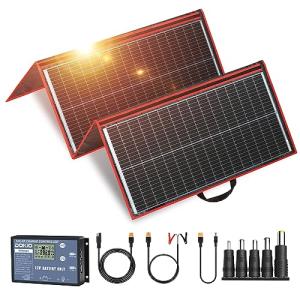
The portability claim on solar panels has been abused by the industry for years. Products marketed as "compact" often arrive bulky, stiff, and awkward to carry. The CTOLITY 400W takes a different approach with a genuine multi-fold architecture that collapses the panel to a manageable suitcase form factor.
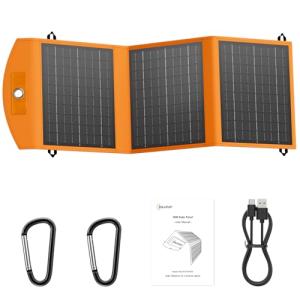
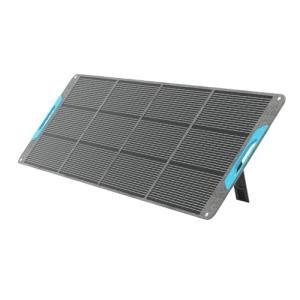
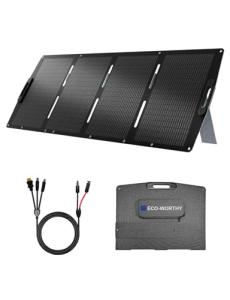
The panel folds down to just 19 x 32 x 2.5 inches and weighs approximately 21.6 pounds. A built-in handle makes it easy to carry, while the adjustable kickstands on the back allow you to angle the panel toward the sun for maximum efficiency.
That weight-to-output ratio is worth noting. At 400 watts in a package just over 21 pounds, you're getting serious generation capacity without sacrificing the ability to load it into a truck bed, strap it to an RV exterior, or haul it to a campsite. The handle isn't an afterthought either — it's integrated into the design to make single-person transport genuinely practical.
When you get to your destination, setup is not a multi-step production. Unfold the panel, extend the kickstands, point it toward the sun, and plug it in. The whole process takes under a minute for anyone who's done it once.
The Adjustable Kickstand: A Small Detail With Big Consequences
Anyone who's owned a solar panel without an adjustable stand knows the frustration. You prop it against a rock at an awkward angle, the wind shifts it, and suddenly your 400W panel is generating 180W because it's facing the wrong direction.
The kickstand system allows the panel to be placed firmly on any flat surface, and with just a few seconds of adjustment, the panel starts pulling energy from the sun at the optimal angle.
The ability to track the sun throughout the day — tilting the panel in the morning toward the east, adjusting at midday, and shifting again in the afternoon — can meaningfully increase total daily energy harvest. This isn't a premium feature reserved for expensive permanent installations. CTOLITY has built it into a portable panel that costs a fraction of a fixed rooftop system.
IP65 Waterproofing: Built for Real Outdoor Conditions
The IP65 waterproof rating means the panel effectively resists water splashes while maintaining durability, engineered to endure temperature extremes from -20°C to -60°C. This rugged construction resists cracking and damage, delivering reliable performance season after season.
Let's translate what IP65 actually means for real-world use. The "6" in the rating indicates complete protection against dust ingress — critical when you're camping in desert environments or dusty backcountry roads. The "5" means protection against water jets from any direction. That covers sudden rain showers, splashes from river crossings, morning dew, and the general moisture of a Pacific coast camping trip.
For context, many cheaper portable panels carry no IP rating at all, or achieve only IPX4, which handles light splashing from one direction. The step up to IP65 is the difference between a panel that survives a weekend of real outdoor use and one that requires careful babying every time clouds roll in.
Smart PWM Controller: Protection You Don't Have to Think About
The built-in smart PWM controller protects against reverse polarity, reverse current, overcharging, overcurrent, short circuits, and overloads, keeping devices safe and power flow efficient.
This is the unglamorous but genuinely important engineering that separates a responsible solar product from a liability. When you're charging expensive power stations and electronics in the field, you want the protection built into the panel itself — not relying solely on whatever protection your power station may or may not provide.
The PWM (Pulse Width Modulation) controller actively manages the charge cycle, preventing the kind of electrical events that can degrade batteries over time or, in worst-case scenarios, cause equipment failure. For the average user, this means plug in and forget about it. For the technically minded, it means a properly engineered charging relationship between the panel and whatever it's feeding.
Compatibility: Works With the Ecosystem You Already Own
The CTOLITY 400W is compatible with Jackery and EcoFlow power stations, two of the most popular brands in the portable power station market. This matters because compatibility isn't universal in the portable solar space — connector types, voltage outputs, and communication protocols can create friction between panels and stations from different manufacturers.
The MC4 output connector is the industry standard for higher-wattage solar applications, and it ensures plug-and-play compatibility with a wide range of solar generators beyond just Jackery and EcoFlow. Whether you're running a Bluetti, Anker SOLIX, Zendure, or Goal Zero unit, the chances are strong that this panel connects cleanly.
Real-World Use Cases
Weekend Camping: Two people camping for a weekend typically need to charge phones, a laptop, portable speakers, LED lights, and a small cooler. A 400W panel feeding a 1kWh power station can realistically replenish 300–400Wh of capacity in a solid 5-hour sun day — enough to keep the essentials running indefinitely with smart power management.
RV and Van Life: For RV owners, a 400W portable panel eliminates the need for generator noise and fuel costs during daytime hours. Park the rig, deploy the panel alongside it, and let the sun run the essentials while you're exploring the area on foot.
Emergency Home Backup: When the grid goes down, a portable 400W panel becomes a genuine lifeline. Paired with a 1,000–2,000Wh power station, it can keep medical devices running, maintain phone and communication device charges, power a CPAP machine overnight, and run LED lighting throughout a home during extended outages.
Hiking Base Camp: For multi-day backcountry trips where the group returns to a base camp each night, a panel like this deployed at camp can charge everything while the group is out on the trail. Return to full batteries every evening.
Comparison Table: CTOLITY 400W vs. Top Competitors
| Feature | CTOLITY 400W | EcoFlow 400W | Zendure 400W | AFERIY 400W | Renogy 400W |
|---|---|---|---|---|---|
| Wattage | 400W | 400W | 400W | 400W | 400W |
| Conversion Efficiency | 23% | 22.4% | 22% | 23% | 23%+ |
| Waterproof Rating | IP65 | IP68 | IP65 | IP65 | IP67 |
| Cell Type | Monocrystalline | Monocrystalline | Monocrystalline | Monocrystalline | Monocrystalline |
| Surface Coating | ETFE | ETFE | ETFE | ETFE | ETFE |
| Adjustable Kickstand | ✅ Yes | ✅ Yes | ✅ Yes | ✅ Yes | ✅ Yes |
| PWM Controller | ✅ Built-in | ❌ External | ❌ External | ❌ External | ❌ External |
| Connector Type | MC4 | MC4 | MC4/XT90 | MC4 | MC4 |
| Jackery/EcoFlow Compatible | ✅ Yes | ✅ Native | ✅ Yes | ✅ Yes | ✅ Yes |
| Foldable Design | ✅ Multi-fold | ✅ Multi-fold | ✅ Multi-fold | ✅ Multi-fold | ✅ Multi-fold |
| Temp Range | -20°C to 60°C | -10°C to 65°C | -10°C to 65°C | -20°C to 60°C | -20°C to 60°C |
The built-in PWM controller is a notable differentiator here. Most competitors rely on the power station's own charge management — useful if you always pair with a compatible unit, but a meaningful gap if you're charging across different systems or running directly into batteries.
Who Should Buy This Panel
The CTOLITY 400W is best suited for people who want a single, high-output portable panel that handles the full range of outdoor and emergency use cases without compromise. It's not the lightest panel on the market, and 400W in a foldable form factor will always carry more weight than a 100W option. But if your goal is genuine energy independence — not just trickle-charging a phone — this is the output tier that makes a real difference.
It's a strong fit for RV owners doing extended trips, overlanders who want solar independence at camp, homeowners building a grid-down emergency kit, and serious outdoor enthusiasts who have invested in quality power stations and want to feed them properly.
The combination of 23% efficiency, IP65 protection, built-in PWM management, and universal compatibility adds up to a panel that punches well above its price point in a category that often asks you to choose between portability and performance. Here, you largely get both.
Final Verdict
The portable solar panel market has matured rapidly, and the CTOLITY 400W arrives as a well-engineered, thoughtfully featured option that addresses the real frustrations of outdoor solar charging: slow recharge rates, weather vulnerability, clumsy setup, and compatibility headaches. None of those problems exist here.
At 400 watts with 23% efficiency, IP65 weatherproofing, a genuine kickstand system, and built-in PWM charge protection, this is a panel that earns its place in serious outdoor kits and emergency preparedness setups alike. The freedom it represents — untethered from the grid, charged by the sun, ready for whatever the day brings — is exactly what well-designed portable solar should deliver.