The Solar Panels: 800W of Honest, Everyday Production
The BPS-3000VA's 800W panel array is rated to produce between 4.8 and 6.4 kilowatt-hours of electricity per day under six to eight hours of direct sunlight. That's a meaningful range — in Phoenix or San Diego in July, you'll hit the top end. In Seattle in November, you probably won't. But for the average American home or a well-equipped cabin, that daily output handles more than most people assume.
Consider what 5 kWh per day actually covers: a modern refrigerator running 24 hours consumes roughly 1–1.5 kWh. An LED TV running four hours uses about 0.2 kWh. A laptop working all day might use 0.5 kWh. Lighting, phone charging, a router, a ceiling fan — you're powering a substantial slice of daily residential life before you even get to cooking or laundry.
The panel kit ships with 32 Z-Brackets and all required mounting hardware, which is a detail worth pausing on. Most competing kits at this price point either skip mounting hardware entirely or include a token set of brackets that requires supplemental purchasing. The inclusion of a complete mounting solution, along with a wiring diagram and high-quality cables, signals that BestSunSolar designed this for people who will actually install it themselves rather than hand it to a professional crew.
The panels themselves are monocrystalline — the current industry standard for efficiency in limited roof space — and the system is designed for roof mounting on residential structures, though RV installation is equally supported by the hardware included.
The Battery: 2,560Wh of LiFePO4 Storage and What That Means in Practice
This is where the BPS-3000VA starts to separate itself from cheaper alternatives.
The battery is a 25.6V 100Ah lithium iron phosphate unit rated for over 4,000 charge cycles, delivering 2,560 watt-hours of usable storage. BestSunSolar explicitly positions this as a Powerwall-equivalent — the same fundamental function as Tesla's flagship home battery, at a fraction of the cost.
That comparison deserves some context. Tesla's Powerwall 3 offers 13.5 kWh of storage and retails around $11,500 before installation. The BPS-3000VA's 2.56 kWh is a smaller reservoir, but the chemistry is the same: lithium iron phosphate is the gold standard for residential energy storage because of its thermal stability, long cycle life, and resistance to the kind of degradation that plagues older lithium cobalt oxide batteries.
LiFePO4 batteries now offer 10–15 year lifespans with 6,000+ charge cycles in high-quality implementations, and even at the 4,000-cycle rating on the BPS-3000VA battery, you're looking at well over a decade of daily cycling before meaningful capacity loss. That's important math when you're thinking about return on investment: a battery that lasts 11+ years isn't a consumable, it's infrastructure.
At 2,560Wh, the storage is enough to carry a small home or RV through the night on a day of good solar production. You won't run a central air conditioner on it, but you can run lights, a refrigerator, small electronics, and essential appliances comfortably until sunrise — exactly the use case this system targets.
The 25.6V nominal voltage (a four-cell LiFePO4 series configuration, technically a 24V system) is a mature, well-supported architecture. Charging equipment, inverters, and accessories designed for 24V systems are widely available, which matters if you ever need to expand, repair, or upgrade.
The Inverter: Where the Intelligence Lives
The 3KVA 120V hybrid inverter is arguably the most sophisticated component in the BPS-3000VA package, and it's what elevates this from a simple off-grid kit to a genuinely hybrid system.
The inverter automatically prioritizes solar energy and switches to grid power when needed, providing a continuous and efficient energy supply. That single sentence describes a control logic that would have required separate charge controllers, transfer switches, and configuration work in older system architectures. Here, it's built in.
The practical experience of living with a hybrid solar system with smart grid switching is substantially different from a simple off-grid setup. With a basic off-grid system, you're always watching the battery level — conscious of cloudy days, large loads, and the ever-present risk of discharging below the protection threshold. With smart grid switching, the system takes care of that calculus automatically. On a sunny day, you run on solar. At night or during heavy cloud cover, the battery picks up the load. When the battery runs low, the grid kicks in — seamlessly, without interruption, without you touching anything.
For homeowners in areas with unreliable grid power, this architecture means something else entirely: it's a whole-house backup system that operates continuously, not just when you flip a switch during an outage. The inverter keeps the priority hierarchy intact — solar first, battery second, grid third — and manages all three automatically.
The 3KVA (3,000 VA) rating gives the system enough headroom to run a meaningful set of household loads simultaneously. A 3KVA inverter can power a combination of a refrigerator (150–400W), lighting (50–200W), a laptop or two (100–200W), a TV (50–150W), and a small pump or fan (100–300W) without breaking a sweat. Where it will struggle is with high-draw appliances like electric water heaters, resistance heating systems, or large air conditioners — but those are better handled by grid power anyway, and the hybrid architecture lets you route them accordingly.
Installation: Honest Assessment of What You're Getting Into
BestSunSolar markets this as a complete kit for easy installation, and the claim holds up to scrutiny — with an asterisk.
The "easy" in that description is relative. Compared to designing a solar system from scratch, sourcing compatible components from five different vendors, and wiring everything together while referencing a stack of technical manuals, yes — this is dramatically easier. The components are matched to work together. The wiring diagram is included. The Z-Brackets are in the box.
But solar installation, even simplified solar installation, involves working on a roof, running wiring from the panels to an inverter, connecting a battery bank, and integrating with your home's electrical system. For the RV use case, the installation complexity is lower — a single coach roof, accessible wiring runs, and a self-contained 12V or 24V system. For residential rooftop installation, you may want a licensed electrician to handle the grid connection and any permitting requirements in your jurisdiction.
The kit's inclusion of 32 Z-Brackets (a full mounting set for eight 100W panels or four 200W panels) is a genuine value-add. Z-Brackets are the simplest and most versatile residential mounting solution — they work on virtually any roof type without requiring a professional racking system. The included wiring and cable kit further reduces the ancillary purchasing normally associated with DIY solar builds.
For the hands-on homeowner, weekend warrior, or experienced RV owner, this is a realistic self-install project. For someone who has never worked with electrical systems before, plan for a learning curve — or budget for a professional to handle the integration work.
Who Is This System Actually For?
The BPS-3000VA occupies a specific and well-defined niche in the residential solar market. It's not a whole-home power solution for a family of four in a 2,500-square-foot house with central air and an electric dryer. It's not competing with a 15-panel grid-tie system with a Tesla Powerwall. And it's not a portable generator alternative.
What it is, specifically:
The energy-independent cabin owner. A weekend retreat or full-time off-grid cabin with modest electrical loads is the textbook use case. Four to six kilowatt-hours per day of solar production, 2.56 kWh of overnight storage, and a hybrid inverter that manages it all automatically — that's a complete, reliable power system for a home where people cook, sleep, work, and live without a utility connection.
The serious RV traveler. Full-time RV living demands more than a 200W panel and a group 27 battery. The BPS-3000VA gives a Class A or fifth-wheel owner enough solar production and storage to run the essentials without plugging into shore power every night. The 120V output is fully compatible with standard RV appliances, and the hybrid switching means you can still plug into a campground pedestal when it's available — the system will prioritize your stored solar first.
The grid-connected homeowner building energy resilience. In an era of more frequent grid outages, the hybrid grid-switching capability makes this a practical backup power system that works continuously rather than only during emergencies. It won't power your whole house, but it will keep the lights on, the refrigerator cold, and your phone charged through whatever the utility throws at you.
The solar newcomer. If you've been curious about residential solar but not ready to commit to a full installation with a $20,000+ price tag, the BPS-3000VA is a legitimate way to get real solar experience — real production data, real storage behavior, real cost savings — at a fraction of the investment.
BPS-3000VA vs. The Competition: How It Stacks Up
The 3KW all-in-one solar kit market has gotten competitive. Here's how the BPS-3000VA compares to the closest alternatives:
| Feature | BestSunSolar BPS-3000VA | ECO-WORTHY 800W Kit | Jackery HomePower 3000 | BPS-3000W Pro |
|---|---|---|---|---|
| Solar Panel Capacity | 800W | 800W (4×200W bifacial) | 400W (2×200W) | 1,200W |
| Daily Production | 4.8–6.4 kWh | ~3.2 kWh (4 hrs sun) | ~2.4 kWh | 7.2–9.6 kWh |
| Battery Chemistry | LiFePO4 | LiFePO4 | LiFePO4 | LiFePO4 |
| Battery Capacity | 2,560 Wh (25.6V 100Ah) | 7,168 Wh (2×280Ah) | 3,072 Wh | 2,560 Wh |
| Cycle Life | 4,000+ | 4,000+ | 3,000+ | 4,000+ |
| Inverter Output | 3KVA / 120V | 3,000W | 3,600W | 3KVA / 120V |
| Grid Switching | ✅ Yes (automatic) | ✅ Yes (UPS) | ✅ Yes (20ms) | ✅ Yes (auto) |
| Mounting Hardware | ✅ 32 Z-Brackets included | ✅ Included | ❌ Portable unit | ✅ 48 Z-Brackets |
| Primary Use Case | Residential / RV hybrid | RV / off-grid | Home backup / camping | Medium residential |
| Expandability | Limited | Parallel battery | Up to 24kWh | Limited |
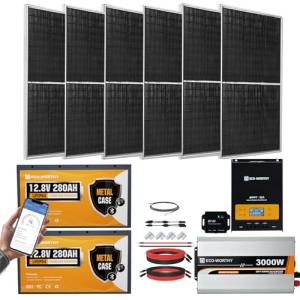
The ECO-WORTHY 800W kit offers significantly more battery storage at 7.168 kWh, which makes it a better option if overnight storage is the primary priority. However, its daily panel production is lower due to the panel angles and efficiency variance of its bifacial configuration in real-world conditions.
The Jackery HomePower 3000 delivers 3,600W continuous output with 7,200W surge capacity and switches power sources in under 20 milliseconds, making it the performance leader among portable alternatives — but its portability comes at the cost of permanent installation capability and long-term cost-effectiveness.
The BPS-3000W Pro is BestSunSolar's own step-up model. It features 1,200W panels producing up to 7.2–9.6 kWh daily and includes 48 Z-Brackets for a larger installation footprint. If you anticipate growing energy needs or have a larger home to power, the Pro is worth the additional investment. The BPS-3000VA is the smarter starting point for most first-time buyers.
The Economics: Solar Tax Credits and Real Payback Math
Solar economics in 2025 favor buyers more than they have in years. The 30% federal tax credit applies to both solar panels and battery storage through 2032, providing substantial savings on typical residential systems. For a system in the BPS-3000VA's price range, that credit can reduce the effective cost significantly — money the federal government is explicitly giving you to make this purchase.
The payback calculation depends heavily on your local utility rates. At the national average of around $0.16 per kWh, 5 kWh of daily solar production saves approximately $0.80 per day, or roughly $292 per year. At California or Hawaii rates (often $0.35–$0.50/kWh), the same production saves $640–$912 annually. In high-cost electricity markets, a system like this can pay for itself in under four years.
For RV owners, the math is different but often even more favorable. Shore power fees at campgrounds range from $5 to $15 per night. A family camping 60 nights per year on stored solar power saves $300–$900 annually in hookup fees alone, before counting generator fuel, oil changes, or the sheer aggravation of running a generator after 10pm.
What BestSunSolar Gets Right
There are three things about the BPS-3000VA that stand out as genuinely well-executed design decisions.
First, the system coherence. Every component in this kit was designed to work with the others. The inverter is matched to the battery voltage. The panel array is sized to charge that battery in a reasonable solar window. The mounting hardware fits the panel dimensions. This sounds obvious, but it's surprisingly rare in the DIY solar market, where mismatched components are responsible for a substantial portion of underperforming systems.
Second, the hybrid architecture. The decision to include smart grid switching rather than a simple off-grid configuration doubles the practical utility of this system. An off-grid kit is only useful where there's no grid — or where you're committed to managing your own power supply manually. A hybrid system works everywhere, for everyone, all the time.
Third, the installation completeness. The 32 Z-Brackets, the wiring diagram, the high-quality cables — these aren't afterthoughts. They reflect an understanding that the buyer of this kit is going to install it themselves, and that a kit without the hardware to actually mount the panels is only half a kit.
Limitations Worth Knowing
Transparency requires acknowledging what the BPS-3000VA doesn't do. The 2,560Wh battery, while capable, won't carry a heavy-use household through a full 24-hour grid outage in summer. Families with electric cooking ranges, window air conditioners, or electric water heaters will find the storage insufficient for extended autonomy. The system is right-sized for modest loads — it doesn't try to be something it isn't, but buyers with larger energy appetites should step up to the BPS-5000W or BPS-10000W tiers in BestSunSolar's lineup.
The 800W panel capacity also means that on short winter days — five hours or fewer of usable sunlight — daily production may fall below 4 kWh. In northern climates, this is a real seasonal constraint. It doesn't invalidate the system, but it's worth factoring into your wintertime expectations.
Final Verdict
The BestSunSolar BPS-3000VA is a well-engineered, genuinely complete solar kit that hits a meaningful convergence point: enough production to matter, enough storage to be useful, and an inverter smart enough to manage the whole system without requiring the homeowner to become an electrical engineer.
The BPS-3000W system suits small homes and off-grid living for users requiring a reliable solar energy solution with integrated storage and grid management. That description is accurate, and it's not a limitation — it's a definition. Know what you're buying, buy it for the right application, and this system will perform.
For the cabin owner, the full-time RV traveler, the resilience-minded suburban homeowner, or the curious first-time solar buyer, the BPS-3000VA represents genuine value — a coherent, capable system that removes the most significant barriers to energy independence: complexity, compatibility, and installation friction.
➡️ Check current pricing and availability on Amazon
Editorial note: This review is based on manufacturer specifications, third-party analysis, and publicly available user data. As with any solar installation, local permitting requirements, roof conditions, and utility interconnection rules vary by jurisdiction. Consult a licensed electrician for grid-tied installations.