What Exactly Is the Renogy 320 Watts Solar Panels 4PCS Kit?
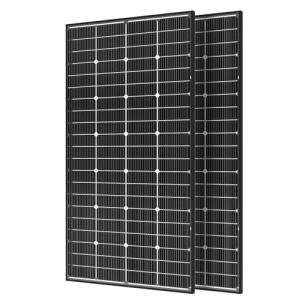
At its core, this is a four-panel bundle of Renogy's flagship 320W N-Type monocrystalline modules, sold as a complete set for on-grid or off-grid applications. Each panel outputs 320 watts, meaning the four together top out at 1,280 watts total — a threshold that opens the door to powering meaningful household loads, not just a phone charger and a camping lantern.
Renogy's 320W panels are constructed using advanced encapsulation material with multi-layered sheet laminations designed to protect cells from physical damage or distortion, finished with an anti-corrosion coating and rated IP68 for weatherproofing. That last detail matters a lot if you're mounting these on an RV roof or an exposed coastal structure where salt air and standing water are a daily reality.
The Technology Behind the Panels — N-Type 18BB Explained
Most budget solar panels still use P-Type silicon cells, which are cheaper to manufacture but carry a well-known weakness: they degrade faster and perform worse in real-world conditions like heat and partial shading. Renogy chose a different path here.
These panels use N-Type cell technology paired with 18 busbars (18BB), which reduces the hot spot effect in harsh weather and delivers up to 25% solar cell efficiency along with superior temperature tolerance — contributing to extended lifespan and great performance.
To put that 25% efficiency figure in context: most standard P-Type panels on the market operate somewhere between 18% and 21% efficiency. Getting to 25% means you're harvesting meaningfully more electricity from the same physical surface area. For installations where roof or mounting space is limited — RVs, van conversions, cabin rooftops — that difference is the gap between a system that barely covers your needs and one that has headroom to spare.
The 18-busbar design is worth unpacking too. Traditional panels used 3 to 5 busbars — the thin metallic strips that carry current across the cell surface. More busbars mean shorter electron travel paths, less resistive loss, and better performance when individual cells get partially shaded. The N-Type design minimizes hot spots and maintains stable performance under extreme conditions, delivering industry-leading conversion efficiency with enhanced heat resistance for superior long-term energy output.
Real-World Output — What 1,280 Watts Actually Powers
Numbers on a spec sheet are one thing. Here's what 1,280W of solar capacity translates to in practice, assuming 4–5 hours of peak sun per day:
- 5,120–6,400 Wh (watt-hours) of daily generation under good conditions
- Enough to run a mid-size refrigerator, charge a laptop bank, power LED lighting throughout a home, and operate a water pump simultaneously
- Enough to keep a 200Ah lithium battery bank fully topped off through typical daytime usage
- Sufficient input for a cabin running a chest freezer, ceiling fans, and small power tools
Each 320W panel rates up to 1,600Wh of electricity per day, and the design generates electricity with no microcracks to protect batteries and devices — all EL certified. Across four panels, that's a theoretical peak of 6,400Wh daily — solidly in small-home territory for well-optimized off-grid setups.
It also performs 6.7% better than standard 300W models — not a massive jump on paper, but that incremental gain compounded over thousands of hours of operation adds up to meaningful real-world savings and charging speed.
Built to Survive, Not Just Function
Renogy didn't cut corners on physical construction. These 320W panels feature military-grade protection with multi-layer encapsulation and reinforced laminations that shield photovoltaic cells against impact and deformation. The aluminum frame is anodized for corrosion resistance, and the junction box carries an IP68 waterproof rating — meaning it's fully dust-tight and can handle prolonged water immersion.
For people mounting panels on RV rooftops, boat decks, or in coastal areas, IP68 isn't a luxury — it's a necessity. Rain, condensation, salt spray, and road grime are all facts of life, and panels that fail their weatherproofing after a couple of seasons become very expensive paperweights.
The 320W panel also features a 13.5% smaller footprint and 17.2% lighter weight compared to older equivalents, which matters a lot on weight-sensitive platforms like RVs and boats where every pound affects handling.
Installation — Easier Than You'd Expect
One of the persistent frustrations with high-output solar panels is that they often arrive with zero thought given to how you're actually supposed to attach them to something. Renogy addresses this directly.
The panels come with pre-drilled holes on the back, making them ideal for off-grid applications including RVs, rooftops, cabins, and yachts. They're compatible with Renogy's ground mount, Z Bracket, Corner Bracket, Pole Mount, and Tilt Mount accessories.
The MC4 connectors are industry standard, meaning integration with virtually any charge controller or inverter setup is plug-and-play. The panels are compatible with both 12V and 24V systems — wire them in series for 24V operation or in parallel for 12V, depending on your charge controller specs.
For homeowners eyeing the federal tax incentive: buyers can claim up to 30% of their new solar system costs — equipment and installation — through the federal Investment Tax Credit (ITC). On a meaningful 1.28kW installation, that rebate can offset a significant portion of total system cost.
Who Should Buy the Renogy 320W 4PCS Kit?
This kit hits a specific sweet spot that not every product reaches. Here's who it's genuinely a strong match for:
RV owners upgrading from a basic 100W or 200W setup who want to run air conditioning, a full-size fridge, and multiple devices without relying on shore power or a noisy generator.
Cabin and tiny home owners building a complete off-grid electrical system who want high efficiency in a compact panel count. Four panels covering a combined 1,280W is achievable on most cabin rooflines without sacrificing aesthetics.
Boat and marine users who need IP68 waterproofing, compact dimensions, and reliable output in variable conditions. The reduced weight-per-watt of this N-Type design is a real advantage here.
Homeowners adding supplemental solar to reduce grid draw and lower utility bills, especially those in states with strong net metering programs where generation surplus translates directly to bill credits.
Comparison Table — Renogy 320W 4PCS vs. Competitors
| Feature | Renogy 320W 4PCS (1280W) | BougeRV 300W 2PCS (600W) | DOKIO 400W 2PCS (800W) | Callsun 215W 2PCS (430W) |
|---|---|---|---|---|
| Total Output | 1,280W | 600W | 800W | 430W |
| Cell Type | N-Type Mono | P-Type Mono | P-Type Mono | N-Type Mono |
| Busbars | 18BB | 12BB | 9BB | 16BB |
| Cell Efficiency | Up to 25% | 23% | ~20% | 25% |
| IP Rating | IP68 | IP67 | IP65 | IP68 |
| EL Certified | ✅ Yes | ✅ Yes | ❌ Not listed | ✅ Yes |
| Pre-Drilled Mounting | ✅ Yes | ✅ Yes | ✅ Yes | ✅ Yes |
| Warranty | 25-Year Output | 25-Year Output | 5-Year Limited | 25-Year Output |
| 12V/24V Compatible | ✅ Both | 12V Only | 12V/24V | 12V/24V |
| Best For | Home/RV/Cabin/Marine | RV/Camping | Home/Garden | RV/Marine |
The Renogy 4PCS kit stands out not just because of total wattage, but because of the combination of N-Type cells, 18BB design, and IP68 durability at a panel count that makes large-scale installs practical without ordering a commercial pallet.
What Users Are Actually Saying
Real-world feedback on the Renogy 320W panels is consistently positive on performance, with a few notes worth knowing. Users report strong power production even in overcast conditions, though shipping damage is an occasional concern — Renogy's customer service has been noted as quick to resolve these issues, though extra time should be budgeted into project timelines.
The consensus among DIY solar builders is that these panels consistently meet or exceed their rated output, which can't be said for every panel in this price bracket. N-Type cells genuinely do perform better in indirect and diffuse light conditions — something many buyers notice immediately when comparing output logs from cloudy days.
There's no shortage of solar panels on the market, but there is a shortage of solar panels that combine genuine technical advancement — N-Type cells, 18BB architecture, 25% efficiency — with the kind of physical durability that holds up through years of actual outdoor deployment. The Renogy 320W 4PCS bundle does both.
At 1,280 watts total, this kit crosses the threshold from "supplemental power" into "real energy independence." It's sized right for serious RV builds, off-grid cabins, and residential supplemental installations. The pre-drilled mounting, IP68 weatherproofing, EL certification, and broad system compatibility mean you spend less time troubleshooting installation and more time watching your battery percentage climb.
If you're ready to move beyond undersized solar and actually build something capable, the Renogy 320W 4PCS is one of the most complete high-efficiency bundles available at this output level.
➤ Check Current Price on Amazon — Renogy 320W Solar Panels 4PCS (1280W Total)