What Is a Bifacial Solar Panel, and Why Should You Care?
The concept is simple but the performance difference is not. A traditional monofacial solar panel only collects light from the front face. Bifacial solar panels are designed to capture sunlight from both the front and rear sides, unlike traditional monofacial panels. This allows for increased energy production by utilizing both direct sunlight and reflected light.
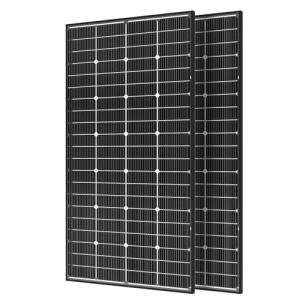
The Epoch 200W takes full advantage of this dual-capture design. Capturing sunlight from both sides, this bifacial solar panel can provide up to 25% more energy compared to traditional solar panels. That's not a marginal gain — that's the difference between running your refrigerator through the night and rationing power before noon.
For RV owners, boaters, and off-grid campers, this matters enormously. Reflected light bounces off sand, water, concrete, snow, and even light-colored boat decks. A bifacial panel harvests that ambient energy that a standard panel simply throws away. In environments with high surface reflectivity — like coastal anchorages or snowbound campsites — the rear-side contribution can be substantial, padding your daily yield without requiring a single additional panel.
The 16BB Cell Architecture: More Busbars, More Power
The "16BB" designation in the product name isn't marketing language — it's a meaningful technical specification. 16BB solar panels use 16 busbars to collect and conduct electricity, resulting in higher efficiency, better performance, and reduced power loss compared to panels with fewer busbars. The increased number of busbars helps to minimize resistance and enhance the panel's durability and energy output.
Most budget-tier solar panels on the market still rely on 9 or 10 busbar designs. The jump to 16 busbars means electrons have shorter paths to travel, which reduces resistive losses throughout the cell. The practical result is a panel that consistently delivers closer to its rated output — not just in a testing lab under ideal conditions, but on an overcast afternoon when your battery bank is sitting at 40% and you need real charging current.
The 16BB cell design is more compact and less affected by shadows compared to common 9BB/10BB solar cells. For mobile applications especially, where tree shadows, antenna masts, and rooftop equipment create partial shading throughout the day, this anti-shade resilience is genuinely valuable. It keeps your system producing power even when conditions aren't perfect — which, in the real world, is most of the time.
Grade A+ Cells and PERC Technology
The Epoch 200W solar panel adopts high-quality Grade A+ solar cells and incorporates PERC, half-cut cell, bypass diodes, and 10 busbar technologies. It can maximize energy output even when partially shaded and protect the solar cells from overheating.
PERC — Passivated Emitter and Rear Cell — technology adds a reflective layer at the back of each cell that bounces unabsorbed photons back into the silicon for a second bite at the apple. Combined with the half-cut cell design (which splits each cell in half to reduce internal resistance and the impact of hot spots), the result is a panel that runs cooler, degrades more slowly, and produces more energy per square foot than conventional designs.
The bypass diodes are worth mentioning specifically. When a section of a solar panel is shaded, bypass diodes route current around the affected cells rather than letting the shaded section drag down the entire panel's output. In mobile applications — where your panel is in constant motion relative to the sun and surrounding objects — this feature alone can meaningfully improve real-world daily energy harvest.
12V and 24V Compatibility: Built for Every Setup
One of the more practical design choices Epoch made with this panel is its compatibility with both 12V and 24V battery systems. The optimal operating voltage of this 200W solar panel is 21.08V, making it suitable for charging a 12V marine battery. Pair it with an MPPT charge controller and it works seamlessly across a wide range of off-grid configurations.
For those running 24V lithium systems — increasingly common in newer RV builds and liveaboard sailboats — the panel's voltage characteristics allow flexible series and parallel configurations. Solar panels can be connected in either series or parallel depending on your electrical circuit size and power needs. When connected in series, the voltage increases while the current stays the same. Connecting panels in parallel increases the current while the voltage remains constant.
This flexibility means the Epoch 200W scales with your system. Start with one panel and expand later. Wire two in series for a 24V setup or parallel them to double your charging current. The panel doesn't lock you into a single architecture.
IP68 Weatherproofing: Engineered for the Elements
Off-grid living is not a controlled environment. Torrential rain, salt spray, heavy dew, dust storms, and temperature swings between freezing nights and scorching afternoons are all part of the package. The Epoch 200W was built to handle all of it.
The IP68 Junction Box ensures waterproof protection, and the IP67-rated solar connectors are versatile due to their ability to withstand dirt, dust, debris, and low-pressure water jets.
IP68 is the highest standard waterproofing rating available in this class of solar equipment. It means the junction box — where your wiring connects to the panel — is fully sealed against water ingress, even under sustained submersion. For boat and marine applications especially, this rating isn't a nice-to-have. It's a necessity. Salt air corrodes electrical connections faster than almost anything, and a compromised junction box can take an entire solar array offline.
These 200W solar panels feature a black corrosion-resistant aluminum frame, which can withstand strong winds of 2400Pa and snow loads of 5400Pa. That wind rating translates to roughly 50 mph sustained winds, and the snow load rating means the panel can sit under a significant accumulation of wet snow without structural damage. These aren't the specs of a panel designed to be brought inside during bad weather. This is a panel designed to stay mounted and keep working no matter what the sky does.
Installation: Designed for the Real World
A solar panel's technical specifications only matter if you can actually get it mounted and wired. The Epoch 200W addresses this with a pragmatic installation design that works for weekend DIYers and experienced van-lifers alike.
Pre-drilled holes on the back of the panel allow for fast mounting and securing, ideal for off-grid applications including RVs, rooftops, cabins, yachts, and more. The panel comes with a junction box and solar connectors already attached. The MC4-compatible connectors are the industry standard, meaning they work with virtually every charge controller, combiner box, and cable extension on the market.
The corrosion-resistant aluminum frame provides solid mounting points for Z-brackets, tilt mounts, or flush roof mounts. The panel's dimensions are optimized for RV rooftop installations — compact enough to fit in tight spaces, large enough to deliver meaningful power.
Real-World Performance: What to Actually Expect
The 200W rating is measured under Standard Test Conditions — 1,000 W/m² of irradiance, 25°C cell temperature, and a specific light spectrum. Real-world output is always lower than STC, and any honest manufacturer will tell you that. What separates good panels from great ones is how much of that rated output they actually deliver under normal conditions.
In testing one panel on a cold December day late in the afternoon, one user was able to pull 60 watts — which was impressive given the conditions. Based on the performance of another known panel at the same time, the Epoch-class panel should output about 170 watts with ease under favorable conditions. The shadow effect on this panel is much less than other panels tested.
That 170-watt figure in good conditions represents roughly 85% of rated capacity — a strong real-world performance ratio for a panel of this type. For context, in 5 peak sun hours per day, that translates to around 850 watt-hours of daily energy. That's enough to run LED lighting, charge devices, power a 12V refrigerator, and still have capacity to spare.
Comparison: Epoch 200W 16BB vs. The Competition
| Feature | Epoch 200W 16BB | BougeRV 200W 16BB N-Type | HQST 200W N-Type 16BB | JJN 200W 16BB N-Type |
|---|---|---|---|---|
| Cell Type | Monocrystalline PERC | N-Type TOPCon | N-Type | N-Type |
| Busbars | 16BB | 16BB | 16BB | 16BB |
| Bifacial | ✅ Yes | ✅ Yes | ✅ Yes | ✅ Yes |
| Efficiency | Up to 25% | 25% | Up to 25% | 25%+ |
| Voltage Compatibility | 12V / 24V | 12V / 24V | 12V / 24V | 12V / 24V / 48V |
| Waterproof Rating | IP68 (junction box) | IP67 | IP67 | IP65 (junction box) / IP67 (connectors) |
| Wind Load Rating | 2400 Pa | 2400 Pa | 2400 Pa | 2400 Pa |
| Snow Load Rating | 5400 Pa | Not specified | Not specified | 5400 Pa |
| Frame | Black aluminum | Black aluminum | Black aluminum | Black aluminum |
| Pre-drilled Holes | ✅ Yes | ✅ Yes | ✅ Yes | ✅ Yes |
| Best For | RV, Marine, Off-Grid | Van builds, Off-Grid | RV, Marine, Roof | RV, Home, Marine |
| Amazon Availability | ✅ In stock | ✅ In stock | ✅ In stock | ✅ In stock |
The Epoch 200W holds its own against every major competitor in this category. Where it differentiates most notably is in its IP68 junction box rating — a step above the IP65 found on some competitors — and its inclusion of bypass diodes with PERC half-cut cell technology, which provides a meaningful edge in shaded or partially obstructed installations.
Who This Panel Is For
The Epoch 200W 16BB Bifacial is not a panel for someone who needs an occasional top-off charge for a phone. It's a workhorse module for people who have committed to life away from the grid — full-time RVers managing a full 12V system, cruising sailors who need to keep a battery bank charged through weeks of passages, overlanders running refrigerators and water pumps off their roof, and off-grid cabin owners who want a compact, high-output panel that won't corrode, crack, or underperform after two seasons.
The bifacial design rewards smart installation — mounted with clearance above a reflective surface, angled to maximize ground-bounce contribution, and paired with a quality MPPT controller that can take full advantage of the panel's voltage characteristics. Done right, this setup quietly delivers more energy than its rated wattage suggests is possible.
At 200 watts, with 16BB cell architecture, bifacial dual-side energy capture, Grade A+ PERC cells, IP68 waterproofing, and a robust aluminum frame rated for serious wind and snow loads, the Epoch 200W Bifacial Solar Panel represents a genuine step forward in what an off-grid solar module can deliver.
It's the kind of panel you buy once, mount properly, and then largely stop thinking about — because it just works. In sun, in partial cloud, on a rocking boat, on a dusty desert highway, through a mountain winter — it keeps converting photons into power with a consistency that, once you've experienced it, makes going back to the grid feel like an unnecessary inconvenience.
→ Check current price and availability on Amazon