What You're Actually Getting
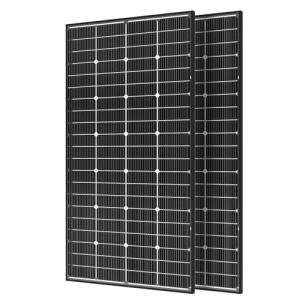
The ECOBOSS 200 Watt Solar Panel kit ships as two individual 100W panels, designed to be wired in parallel for a combined 200W output on a 12V system. This modular approach isn't just clever marketing — it solves a real problem for RV owners and boaters who have limited roof space, irregular mounting surfaces, or need to split panels across different orientations. Two smaller panels give you flexibility a single 200W slab simply cannot.
Each panel is built around N-Type monocrystalline silicon cells — a notable step up from the P-Type cells that still dominate the budget end of the market. N-Type cells carry fewer impurities, meaning they resist the light-induced degradation that causes many P-Type panels to lose 2–3% of their rated capacity within the first year of outdoor use. With ECOBOSS, what you install is closer to what you keep, year after year.
Key Specifications at a Glance
- Combined output: 200W (2 × 100W panels)
- Cell type: N-Type Monocrystalline
- Conversion efficiency: Up to 25.6% (STC)
- Busbar design: 16BB (16-busbar high-density grid)
- System voltage: 12V (MPPT / PWM compatible)
- Projected lifespan: 30 years
The Technology Behind the Numbers
N-Type Cells: Why the Silicon Chemistry Matters
Solar panel cells come in two fundamental flavors — P-Type, doped with boron, and N-Type, doped with phosphorus. The difference sounds academic until you look at real-world aging data. P-Type cells suffer from boron-oxygen bonding when exposed to sunlight, which permanently reduces their output. N-Type cells don't have this problem. They maintain output more consistently through their operational life, which is exactly why the commercial solar industry has been migrating toward N-Type cells for utility-scale installations. ECOBOSS brings that same cell chemistry to a 100W portable panel format.
16BB: Sixteen Busbars and Why They Matter
Traditional solar panels used 3–5 busbars — the thin silver conductors that collect current from individual solar cells. The 16BB (16 busbar) architecture distributes that current collection across sixteen fine conductors instead. The result is twofold: electrons travel shorter distances before reaching a busbar, reducing resistive losses, and the risk of micro-cracks causing catastrophic current loss drops significantly. If a cell develops a hairline crack in a 3-busbar panel, the current loss can be large. In a 16BB panel, the redundancy of nearby conductors means the same crack has far less impact on total output. For panels mounted on vehicles or boats — where vibration is a constant reality — that crack resistance matters.
25.6% Efficiency in Context
Standard P-Type monocrystalline panels hover between 18% and 22% efficiency under standard test conditions. Premium N-Type panels like these push toward 25–26%. In practical terms, for a given panel size, the ECOBOSS generates more watts per square foot than the majority of the market. That's meaningful when you're working with a 21-foot RV roof or the deck of a 28-foot sailboat where every inch is spoken for.
How It Performs in Real-World Conditions
Manufacturers test panels at 25°C (77°F) under 1000 W/m² irradiance — conditions that don't exist on your RV roof in July. What matters in practice is the temperature coefficient. ECOBOSS N-Type panels carry a low temperature coefficient of approximately -0.3%/K, meaning that for every degree Celsius the panel rises above 25°C, output drops by only 0.3%. Comparable P-Type panels typically run -0.35% to -0.45%/K. On a hot summer day when a dark panel surface hits 55°C, that difference translates to 3–4 additional watts per 100W panel — modest in isolation, but meaningful across a full day of charging.
Low-light performance is another area where N-Type cells demonstrate their advantage. On overcast mornings, during golden hour, or when a panel is partially shaded, N-Type cells continue producing proportionally more current than their P-Type counterparts. If your RV spends time in the Pacific Northwest or you frequently sail under cloud cover, this is a real-world benefit rather than a spec-sheet talking point.
Build Quality and Durability
The ECOBOSS 200 Watt Solar Panel 2-Pack is constructed with tempered glass and a corrosion-resistant aluminum frame — the same basic construction you'd find on commercial rooftop installations. Pre-drilled mounting points simplify installation on standard RV rail systems or marine mounting hardware. The junction box and cable connectors use industry-standard MC4 fittings, meaning they'll mate directly with virtually every solar charge controller and extension cable on the market without adapter headaches.
The projected 30-year operational lifespan comes from the combination of N-Type cell stability and quality encapsulation materials. While no consumer can verify a 30-year claim at purchase, it reflects the underlying cell chemistry — N-Type cells simply degrade more slowly. Renogy, a well-regarded name in the RV solar segment, quotes similar figures for their own N-Type 16BB lineup, and the engineering rationale is consistent across manufacturers using this cell type.
Who Should Buy the ECOBOSS 200 Watt Solar Panel 2-Pack
RV and Van Life
Perfect for Class B and C RVs needing a scalable 12V charging solution without roof-space compromise. The two-panel format allows placement on separate roof sections or one panel fixed and one tilted for seasonal angle optimization.
Marine and Sailboats
Compact panels with vibration-resistant 16BB cells suit offshore and coastal marine environments. MC4 connectors are easy to weatherproof, and the lower weight per panel compared to a single 200W module simplifies handling on deck.
Off-Grid Cabins
Combine multiple 2-packs to build a full cabin system — each pair adds another 200W to your array. The modular format means you can start small and expand without rewiring your entire setup.
Portable Power Stations
MPPT-compatible design works with most modern portable power stations for fast solar recharging. High efficiency in a compact form factor means shorter recharge windows on sunny days.
Emergency Backup
Reliable long-term storage and low degradation make these a sensible choice for emergency preparedness setups. A panel that holds its rated output after years in storage is genuinely more valuable in a backup scenario than one that has degraded 10% sitting in a garage.
System Expanders
Already have 100W on the roof? Add this 2-pack to double or triple your daily harvest without rewiring your existing charge controller, as long as its maximum PV input rating accommodates the additional panels.
ECOBOSS 200W vs. Competing 200W Solar Panels — Comparison Table
Here's how the ECOBOSS 200 Watt Solar Panel 2-Pack stacks up against comparable offerings in the 200W class.
| Feature | ECOBOSS 200W (2-Pack) | Renogy 200W N-Type | ECO-WORTHY 200W | Callsun 200W Bifacial |
|---|---|---|---|---|
| Cell type | N-Type Mono | N-Type Mono (TOPCon) | P-Type Mono | N-Type Bifacial |
| Efficiency | 25.6% | ~25% | ~25.2% | ~25% |
| Busbar count | 16BB | 16BB | Not specified | 16BB |
| Format | 2 × 100W (modular) | 1 × 200W | 1 × 200W | 1 × 200W (bifacial) |
| System voltage | 12V | 24V | 12V | 12V / 24V |
| Temperature coefficient | ~-0.30%/K | ~-0.30%/K | ~-0.38%/K | ~-0.30%/K |
| Light-induced degradation resistance | High (N-Type) | High (N-Type) | Standard (P-Type) | High (N-Type) |
| Rear-side power gain | No | No | No | Yes (~10–25% extra) |
| Modular / splittable layout | Yes (2-panel pack) | No (single panel) | No (single panel) | No (single panel) |
| Projected lifespan | 30 years | 30 years | 25 years | 25 years |
| Best suited for | RV, marine, off-grid, modular systems | 24V van / Class B systems | Budget 12V installs | Rooftop, farm, fixed installs |
Efficiency and temperature coefficient figures are manufacturer-stated STC values. Real-world output varies with installation angle, temperature, and shading conditions.
Installation and Compatibility
The two-panel format opens up wiring configurations that a single large panel doesn't. Wire both 100W panels in parallel and you get a combined 200W output at 12V — correct for direct battery charging through a PWM or MPPT controller. If you need higher voltage for a 24V system, wire them in series. The flexibility is particularly useful for boaters who may need to position the two panels on different parts of the vessel to avoid rigging shadows, or for cabin owners who want one panel on the south roof slope and one on the east face.
Standard MC4 connectors mean compatibility with the vast majority of charge controllers, portable power stations, and extension leads sold in North America and Europe. Installation hardware is minimal — the pre-drilled aluminum frame accepts Z-brackets, tilt mounts, or roof rails depending on your application.
Expanding Your System
One of the more compelling aspects of the ECOBOSS product family is the logical upgrade path. Start with the 200 Watt 2-Pack for a 200W array. When your power needs grow — a second air conditioner, a larger battery bank, a 12V refrigerator — the ECOBOSS 400W 4-Pack uses the same 100W panels, meaning your wiring, mounting hardware, and charge controller infrastructure can often be reused. The 200W single-panel ECOBOSS variant is also available for those who prefer fewer but larger modules. The consistency of the product line makes capacity planning straightforward in a way that mixing brands never quite achieves.
Honest Considerations Before You Buy
No product review is complete without a candid look at limitations. The 25.6% efficiency figure is a peak value under standard test conditions — a temperature of exactly 25°C and irradiance of exactly 1000 W/m². Real-world output, as with every solar panel on the market, will be lower. Morning and evening sun angles, partial cloud cover, panel temperature on hot days, and cable resistance all take a bite out of peak wattage. ECOBOSS acknowledges this in their own product language. Budget on seeing 70–85% of rated output as your practical daily average in good conditions.
The panels are designed for 12V systems, which suits the majority of RV, marine, and portable off-grid applications. Users building a 24V or 48V system for a larger cabin should factor in the wiring requirements of series connections or consider the single 200W ECOBOSS panel designed specifically for 24V configurations.
The ECOBOSS 200 Watt Solar Panel 2-Pack sits in a sweet spot between budget monocrystalline panels and premium bifacial systems. The N-Type 16BB cell combination delivers efficiency and longevity that exceeds most panels in this price category, and the two-panel format solves real installation challenges that a single 200W slab cannot. For RV owners, boaters, and off-grid cabin builders who want technology that will still be performing well a decade from now, this is one of the stronger value propositions in the 200W class.