Built Like It Means It: The Battery and Housing
The EBL Booster carries an automotive-grade LiFePO4 battery with 3,000+ charge cycles and a built-in 15-layer protection system, certified under UN38.3 and UL498 standards. That's not just marketing language. LiFePO4 chemistry is meaningfully different from older lithium-ion formulations — it runs cooler, degrades more slowly, and is considerably more stable under physical stress. For a device you're throwing in a truck bed, strapping to a backpack, or storing in a garage, that matters.
The unit survives 1-meter drops and operates across a temperature range of -20°C to 60°C, which covers everything from a frozen January power outage to a desert summer campsite. This kind of ruggedness isn't common at this price tier, and EBL has earned the "military-grade" descriptor they've attached to it.
The 238Wh capacity lives in a chassis that weighs just 7.27 pounds — light enough to carry one-handed without strain, compact enough to slide under a car seat or fit inside a medium-sized daypack. For a unit with this level of output capability, the form factor is genuinely impressive.
Power Output: More Ports Than You'll Probably Use
One of the real differentiators in the portable power station category is port variety, and EBL has stacked the Booster generously. The output configuration includes a 110V pure sine wave AC outlet, a 60W USB-C port, a 20W USB-C port, dual 18W USB-A ports, a DC port, and an integrated LED light.
The pure sine wave designation on the AC output is worth dwelling on. Many cheaper power stations ship with modified sine wave inverters that can damage or degrade sensitive electronics — think CPAP machines, medical devices, camera battery chargers, and certain laptop power supplies. Pure sine wave output matches the quality of standard wall power, meaning you can plug in essentially any consumer device without worrying about long-term compatibility issues.
The 60W USB-C port handles fast charging for modern laptops, which has become a non-negotiable for remote workers and students who bring their machines into the field. Pair that with the dual 18W USB-A ports and you can simultaneously fast-charge a phone on each USB-A port while running a laptop through the USB-C — before you've even touched the AC outlet.
The EBL Portable Power Station can handle up to 9 devices at once, which in practical terms means a campsite full of people can all stay charged off a single unit without anyone waiting their turn.
The Solar Panel: Where the Kit Earns Its Price
A lot of "solar generator kits" bundle an underpowered, flimsy panel as an afterthought. The EBL 40W foldable panel is a genuine piece of hardware. It uses monocrystalline cells with a 23.4% conversion efficiency and is built with ETFE waterproof technology — the same surface material used on higher-end panels designed for marine and aerospace applications. ETFE is more durable than the cheaper PET plastic found on budget panels, resists UV degradation, and stays cleaner in outdoor conditions.
The panel weighs just 2.2 pounds, making the entire kit — station and panel combined — under 10 pounds total. That's a complete off-grid power system you can carry in one trip from the car to the campsite.
The panel connects via an MC4-Anderson connector that's included in the box, and the design is compatible with expansion — if you need more charging speed, the kit includes the MC4-Anderson cable, AC charger, car charger, and user manual to get you up and running immediately.
Charging Speed: 65% in an Hour Is the Real Story
The Booster reaches 65% charge within one hour via AC, solar, or car charging. That's a strong number. Full recharge via AC takes roughly 2 hours under optimal conditions, which means you can top off overnight and wake up to a full unit before a day trip.
The unit can charge 19 smartphones, 4 laptops, or 7 drones on a full charge — useful context for understanding real-world capacity. For a weekend camping trip where the priority is keeping phones, a camera, and a laptop alive, 238Wh is more than adequate. It's not a whole-home backup system; it's not trying to be. It's sized for what most people actually need when they leave the house.
The LCD power monitor keeps you informed of remaining capacity and input/output wattage in real time — a feature that's easy to overlook until you're trying to figure out if you have enough juice to run the coffee maker before breaking camp.
ECO Mode and the LCD Monitor: Smart Power Management
The built-in ECO mode is a small but genuinely useful feature. When enabled, the unit automatically reduces power consumption when connected devices are drawing minimal load, extending the effective run time during low-demand situations like overnight phone charging or running a small LED lantern. For multi-day trips where every percentage point of battery matters, ECO mode can meaningfully extend how long you go between recharges.
The LCD screen provides a clean, readable readout of battery percentage, input wattage, and output wattage. No app required, no Bluetooth pairing — just a straightforward display that works in sunlight, which is more than can be said for some competitors who have pivoted entirely to app-based interfaces.
Real-World Use Cases
Weekend camping: The Booster 300W handles the typical camping electronics load without drama. Phone charging, a portable Bluetooth speaker, a small fan, camera batteries, and a headlamp charger — you'll get through a long weekend without solar input. Add the 40W panel for a day in the sun and you'll arrive at Sunday evening with more charge than you started with.
RV and van life: The unit's lightweight build makes it easy to position near a window for solar charging during drives or stationary days. The pure sine wave AC output means your devices are protected, and the multiple USB ports handle charging for the whole vehicle.
Emergency home backup: A 238Wh station won't run your refrigerator indefinitely, but it will keep phones charged, power a CPAP machine through the night, run a small fan, and keep lights on during a multi-hour outage. As a first layer of emergency preparedness, it's a practical and affordable option.
Remote work: Journalists, field researchers, photographers, and outdoor educators who need reliable laptop power away from infrastructure will find the 60W USB-C output and pure sine wave AC sufficient for a full workday of laptop and camera use.
Comparison: How the EBL Booster 300W Stacks Up
| Feature | EBL Booster 300W Kit | Jackery Explorer 300 Plus | EcoFlow River 2 | Goal Zero Yeti 200X |
|---|---|---|---|---|
| Battery Capacity | 238Wh | 288Wh | 256Wh | 187Wh |
| Battery Type | LiFePO4 | LiFePO4 | LiFePO4 | Li-NMC |
| Cycle Life | 3,000+ | 3,000+ | 3,000+ | 500 |
| AC Output | 300W (Pure Sine) | 300W (Pure Sine) | 300W (Pure Sine) | 200W (Pure Sine) |
| USB-C Output | 60W + 20W | 100W | 60W | 18W |
| Solar Panel Included | ✅ 40W | ❌ Sold Separately | ❌ Sold Separately | ❌ Sold Separately |
| Weight (Station Only) | 7.27 lbs | 7.49 lbs | 7.7 lbs | 5 lbs |
| Drop Resistance | 1m | Not rated | Not rated | Not rated |
| Operating Temp | -20°C to 60°C | -10°C to 40°C | -20°C to 60°C | 0°C to 40°C |
| LCD Display | ✅ | ✅ | ✅ | ✅ |
| ECO Mode | ✅ | ✅ | ✅ | ❌ |
| Certifications | UN38.3, UL498 | CE, FCC | FCC, CE, UL | UL |
The comparison tells a clear story. The EBL Booster's single most significant competitive advantage is that it arrives as a complete system. Every other unit on this list requires a separate solar panel purchase to get to the same functional starting point — typically adding $80–$150 to the total cost. Factor that in, and the EBL kit represents strong value.
On pure hardware specs, the LiFePO4 chemistry and 3,000-cycle rating put it in the same tier as Jackery and EcoFlow at this capacity level, and well ahead of older NMC chemistry used in the Goal Zero Yeti 200X. The drop resistance rating and extended operating temperature range are genuine differentiators for anyone using gear in physically demanding environments.
What's in the Box — No Surprises
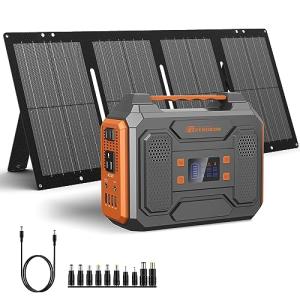
The complete kit includes the EBL 300W solar power station, the EBL 40W solar panel, an MC4-Anderson cable, an AC wall charger, a car charger, and a user manual. That's everything required for all three charging modes on day one — no hunting for compatible cables, no separate purchases before the first trip. It's a detail that speaks well of EBL's understanding of who actually buys these products and how they use them.
The EBL Booster 300W Solar Generator Kit is a thoughtfully engineered, complete power solution for people who spend time away from the grid by choice or necessity. Its LiFePO4 battery, pure sine wave AC output, military-grade durability ratings, and the inclusion of a capable 40W solar panel make it one of the more honest value propositions in the portable power category.
It won't power a full household through a multi-day outage. It's not designed to. What it does — reliably keeping phones, laptops, cameras, fans, and small appliances running through a weekend away or an overnight grid failure — it does extremely well, in a package light enough to actually bring along without thinking twice about it.
For the traveler, the camper, the remote worker, and the prepared homeowner, the EBL Booster 300W is a capable, honest piece of gear worth its space in the pack.