The Power Outage Problem Nobody Plans For
There's a particular kind of helplessness that sets in when the lights go out and your phone is at 12%. The fridge hums to a stop. The CPAP machine beside the bed goes silent. The router blinks off. And suddenly, the modern home feels very fragile indeed.
For most people, the standard response is to do nothing until the grid comes back — sometimes in an hour, sometimes in 12, occasionally in days. The Anker SOLIX C1000 Gen 2 is designed for the people who've decided that's no longer good enough.
At its core, this is a 1,024Wh portable power station with a 2,000W continuous output, a sub-49-minute full recharge time, and a battery chemistry built to last a decade. But the numbers alone don't capture what makes this a genuinely compelling piece of equipment. What makes it interesting is the engineering decisions Anker made — and, equally, the tradeoffs they accepted — in getting it to this point.
Design: Compact Is the Point
The Anker SOLIX C1000 Gen 2 features a compact, rectangular design measuring 15.12 × 8.19 × 9.61 inches and weighing approximately 24.9 lbs. That sounds like a lot until you pick it up with one hand and realize it's lighter than a full case of bottled water.
Anker claims the C1000 Gen 2 is 14% smaller and 11% lighter than similar models in its class. That's not marketing fluff — it's the kind of difference you notice when you're moving it from the garage to the living room, or hauling it to the back of an SUV for a camping trip.
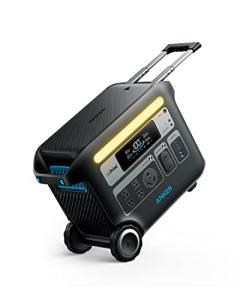
The aesthetic is utilitarian without being ugly: black and gray plastic with rubberized corner feet, dual side handles for two-handed carrying, and fan grilles that flank the sides. The front panel is where the real estate gets interesting. Four 15-amp AC outlets sit alongside a single 20-amp AC outlet, three USB-C outlets, one USB-A outlet, a color display, and a power button — all conveniently grouped on the front face.
The LCD screen deserves a mention. It's bright enough to read in direct sunlight, and it displays not just battery percentage but real-time power draw and estimated runtime. In a grid-down situation, that kind of at-a-glance data is genuinely reassuring.
One notable omission: there's no built-in LED flashlight. The previous generation of the C1000 had an integrated LED floodlight, which Anker removed in the Gen 2 — a small but real concession when you're using this thing in a dark house during a storm.
Battery: LiFePO4 and Why It Matters
Not all batteries are created equal, and the choice of chemistry matters more than most buyers realize. The Anker SOLIX C1000 Gen 2 uses next-generation lithium iron phosphate (LFP) chemistry — the most stable battery technology currently in use at scale, and one that supports a very large number of charge cycles.
After 4,000 charge cycles, the battery still retains at least 80% of its capacity — the equivalent of nearly daily use for a decade. Competing units using NMC (nickel manganese cobalt) chemistry typically degrade meaningfully faster, often losing significant capacity within 500–800 cycles. For a product that lives in your garage and gets pressed into service during emergencies, the longevity math matters.
The 1,024Wh capacity is genuinely useful. To put it in practical terms: a typical home refrigerator running at around 150W could be kept running for roughly 5–6 hours. A laptop charging at 65W gets around 15 full charges. A CPAP machine at around 30–40W could run through two full nights of sleep. These aren't numbers to live off indefinitely, but they're more than enough to bridge a typical outage — which, according to FDA and federal data, averages around 12 hours.
Charging Speed: The Headline Feature
The number that Anker leads with — and the one that genuinely sets the C1000 Gen 2 apart from much of its competition — is 49 minutes for a full charge. This is made possible by upgraded HyperFlash technology that charges at up to 1,600W and is enabled through the Anker app.
In standard mode, the unit draws around 1,200W, still fast enough to reach full capacity in roughly an hour. The difference between standard and HyperFlash mode is roughly 10–15 minutes of charge time, at the cost of fan noise and slightly accelerated wear — which is why Anker gates it behind the app and recommends using it only when speed is essential.
The 49-minute full-charge claim has even earned a Guinness World Record for the fastest portable power station charge time as of April 2025. Whether or not you care about world records, what it means in practice is that you can top this off between camping days, before a storm rolls in, or during a brief window at a friend's house — and have full power waiting on the other side.
There is a significant tradeoff: when charging at full speed, the fans run loud. Loud enough that sleeping in the same room with them running is genuinely uncomfortable. At lower draw, the unit is nearly silent. This is a fair bargain — fast charging and quiet operation are competing physics — but it's worth knowing before you decide where to station this thing overnight.
Solar Charging: Going Fully Off-Grid
For off-grid scenarios, the C1000 Gen 2 accepts up to 600W of solar input at a maximum of 60V, and can reach full charge in as little as 1.8 hours under ideal conditions with a maxed-out panel array.
The solar input connector is an XT60i port — a standard connector type that accepts a wide range of third-party solar panels via commonly available adapters. This means you're not locked into Anker's own panel ecosystem, though their panels are designed to work seamlessly with the unit.
Beyond solar and AC, the unit supports charging via car auxiliary port, gas generator, or simultaneously through both AC and solar, with solar power prioritized. Six charging methods in total is a serious convenience for anyone who moves between environments — home, vehicle, campsite, jobsite.
Output Power: 2,000W With a 3,000W Safety Net
The 2,000W continuous AC output, combined with 3,000W surge capacity via SurgePad technology, is sufficient to run most essential home appliances — including a full-size refrigerator, a coffee maker, or an electric kettle.
The port breakdown is: five 120V AC plugs (up to 2,000W total continuous output, 3,000W peak at 15A), three USB-C ports with two at 140W and one at 20W, one USB-A port, and a 12V/10A DC car charger port with up to 120W output. That's ten outputs in total, which means this can realistically serve as a household power hub for multiple people simultaneously.
The two 140W USB-C ports are a meaningful upgrade over the previous generation. These ports are fast enough to charge laptops, tablets, and flagship smartphones simultaneously at full speed — a capability that's increasingly important as USB-C becomes the universal standard across devices.
One honest caveat: the C1000 Gen 2 is not ideal for inductive load devices or compressor-based equipment such as pumps and electric saws, as their high instantaneous startup power can exceed the maximum output even with the 3,000W surge provision. This isn't unusual for power stations in this class, but it's worth checking your specific appliances before relying on this as a work-site power solution.
UPS Mode: The Feature That Rarely Gets Enough Credit
The C1000 Gen 2 includes a UPS (uninterruptible power supply) mode with a sub-10ms switchover time — meaning that if you plug a critical device (a CPAP machine, a router, a home security system) into the unit and then plug the unit into the wall, it will transition to battery power so quickly during an outage that the connected device never registers a disruption.
Most consumer devices require far more than 10ms to detect a power interruption and respond. In practice, this means the C1000 Gen 2 functions as a seamless, invisible backup for anything plugged into it. For people who depend on medical equipment at night, or for anyone running a home office that cannot afford unexpected reboots, this mode alone can justify the purchase.
App Control: Remote Management Done Right
Anker's companion app connects to the C1000 via Wi-Fi or Bluetooth and allows users to check power level, power draw, and remaining runtime remotely, as well as control AC outputs, fine-tune charging limits, adjust device timeout settings, and manage firmware updates.
The Time of Use (TOU) mode is a lesser-discussed but genuinely useful feature: it allows users to intelligently schedule charging and discharging to avoid peak electricity rates — a real consideration for households in regions with variable utility pricing. For anyone treating this as a semi-permanent home energy solution rather than an occasional camping companion, TOU mode adds a layer of efficiency that pays dividends over time.
Real-World Versatility
Whether powering short-term events outside, charging tools at remote jobsites, or covering appliances during neighborhood maintenance outages, the C1000 Gen 2 handles day-to-day use without drama.
It's compact enough to sit on a kitchen counter during a storm, light enough to carry to a campsite by hand, and capable enough to run a laser engraver, an air purifier, and a laptop simultaneously at a craft show. It performed flawlessly over four days of travel from Southern California to Utah to Nevada, serving as a buffer between an EV and a refrigerator running 24/7.
That versatility — home backup, camping companion, mobile business power supply, EV travel aid — is the strongest argument for its price point.
Comparison: How It Stacks Up Against Rivals
| Feature | Anker SOLIX C1000 Gen 2 | EcoFlow Delta 3 Classic | Jackery Explorer 1000 Pro | Bluetti AC180 |
|---|---|---|---|---|
| Capacity | 1,024 Wh | 1,024 Wh | 1,002 Wh | 1,152 Wh |
| Continuous Output | 2,000W | 1,800W | 1,000W | 1,800W |
| Peak Output | 3,000W | 2,500W | 2,000W | 2,700W |
| AC Recharge Time | 49 min (UltraFast) | ~60 min | ~1.8 hr | ~45 min |
| Solar Input Max | 600W | 500W | 600W | 500W |
| Battery Chemistry | LiFePO4 | LiFePO4 | LiFePO4 | LiFePO4 |
| Cycle Life (80%) | 4,000 cycles | 3,000 cycles | 2,000 cycles | 2,500 cycles |
| AC Outlets | 5 | 4 | 3 | 4 |
| USB-C (Max Wattage) | 140W (×2) | 100W | 100W | 100W |
| Weight | 24.9 lbs | 27.6 lbs | 25.4 lbs | 27.8 lbs |
| UPS Switchover | <10ms | <30ms | Not specified | <20ms |
| MSRP | ~$349–$449 | ~$349 | ~$499 | ~$549 |
| Expandable Capacity | ❌ | ❌ | ❌ | ✅ |
| Built-in LED Light | ❌ | ✅ | ✅ | ✅ |
The Anker wins on raw output power, recharge speed, and UPS response time. It loses on expandability (the Gen 1 supported add-on batteries; the Gen 2 does not) and the missing flashlight. In terms of bang for the buck at its typical sale price, it's among the strongest performers in the 1kWh class.
Who Should Buy the Anker SOLIX C1000 Gen 2?
This power station hits a genuine sweet spot: enough capacity and output to handle real household needs, light and compact enough to take anywhere, and fast enough to charge in less time than it takes to watch a movie.
It's the right choice for homeowners in areas with frequent short outages, campers and overlanders who want real AC power in the field, remote workers and mobile business operators, and anyone whose household includes medical equipment that cannot tolerate power interruptions.
Anker's customer support is widely regarded as among the strongest of any power station brand, which is not a small thing when you're purchasing a product expected to serve as critical infrastructure during emergencies.
At its regular sale price of around $350–$450, the Anker SOLIX C1000 Gen 2 is a serious piece of equipment at a fair price. At MSRP, it competes — but watch for the frequent promotions before pulling the trigger.
👉 Check current price on Amazon