What Makes the Callsun 215W Anti-Shading Bifacial Solar Panel Different
Most solar panels are passive rectangles. The Callsun 215W is an active energy system. The distinction sounds subtle; the difference in daily output is not.
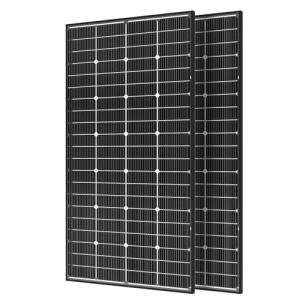
At the heart of the panel are A+ 182mm N-Type monocrystalline cells paired with 16BB (16-busbar) architecture, delivering over 25% conversion efficiency and superior performance in low-light conditions. That 25% efficiency figure places this panel in the same conversation as products costing considerably more — but what really separates the Callsun 215W is the combination of technologies layered on top of that already-exceptional cell quality.
Three distinct innovations work in concert here: Quad-Cell anti-shading architecture, bifacial light capture, and IP68 weatherproofing. Together, they address the three biggest failure points of off-grid solar — shade, limited surface area, and weather damage — with solutions that are measurable rather than marketing language.
Quad-Cell Anti-Shading Technology — The Feature That Changes Everything
Ask any RV traveler or marine user what kills their solar output and they'll give you the same answer: shade. Trees at a campsite. A sail's shadow. An overhanging roof. A bird dropping that landed in exactly the wrong place. Traditional solar panels treat shade as a catastrophic event because a single shaded cell can drag down the output of the entire string.
The Callsun 215W solves this with a Quad-Cell structure that divides the panel into four independent units operating in parallel. When one section is shaded by trees, leaves, or snow, the other three units continue generating power, reducing energy loss by 75–80% compared to standard panels.
In practical terms: if leaves, snow, or dust cover one part, the rest continue operating steadily with unchanged output voltage. It delivers up to 85% less power drop compared to ordinary panels, providing stable, reliable energy all day.
This matters enormously for mobile installations. A campsite under a canopy of trees isn't a dead zone anymore. A boat deck with a boom casting a shadow doesn't bring your charging to a halt. The Callsun 215W keeps working through conditions that would send competing panels into a tailspin.
Bifacial Design — Because the Sun Reflects, Not Just Shines
Callsun bifacial solar panels capture sunlight from both front and rear sides, allowing them to generate more energy than traditional monofacial panels.
The bifacial design captures reflected light from snow, sand, or white roofs on its backside to generate up to 7–30% more energy daily. That rear gain is real and documented. An RV parked on a white concrete pad sees meaningful rear reflection. A marine installation above water benefits from the sun's reflection off the surface. Even a rooftop installation above a light-colored membrane can push rear-side gains well beyond what most users anticipate.
The high-transparency backsheet allows rear reflected light to contribute an additional 5–30% energy gain when installed on reflective surfaces. For a 215W-rated panel, that translates to a real-world operating output that can approach 250W or beyond in optimal conditions — a meaningful bonus on a panel already running at the top of its efficiency class.
N-Type vs. P-Type Cells — Why Cell Chemistry Matters
Not all monocrystalline solar cells are equal, and the gap between N-Type and P-Type silicon has been one of the most significant stories in solar technology over the last five years.
P-Type cells, which dominate older and budget panel designs, are susceptible to Light-Induced Degradation (LID) — a process where exposure to sunlight actually reduces cell efficiency over the first months of use. N-Type cells are largely immune to this effect. The result is a panel that performs closer to its rated specifications not just on day one, but on day 3,000.
N-type solar panels offer higher efficiency, better performance in high temperatures and low light, greater resistance to light-induced degradation, and a longer lifespan compared to P-type panels.
The 16BB busbar technology boosts solar panel efficiency and reliability by minimizing energy loss during transmission. More busbars improve conduction, leading to higher power output and better performance, especially in high temperatures.
For an off-grid user, the significance of that last point cannot be overstated. A panel mounted on an RV roof in summer isn't operating at 25°C — it may be running at 50°C or above. The Callsun 215W carries a low temperature coefficient of -0.3%/K, meaning heat robs this panel of less power than panels with higher temperature coefficients. Every degree matters when you're trying to charge a battery bank in July.
Built for the Real World — Durability, Protection, and Physical Specs
There's a saying among serious off-grid users: a solar panel is only as good as its worst weather day. The Callsun 215W was built with that philosophy in mind.
The panel measures 55.98 × 30.16 × 1.38 inches and weighs 25.38 lbs, offering high power density while saving installation space. For a 215W output, that weight is genuinely competitive — especially when you're thinking about roof load on an RV or deck weight on a sailing vessel.
IP68 waterproof protection fully seals the panel against dust ingress and allows it to withstand heavy rain, splashes, and harsh outdoor environments for long-term reliability. IP68 is the highest standard for dust and water resistance in consumer electronics — the same rating you'll find on premium smartphones. Applied to a solar panel, it means this unit can survive a full deluge, road spray, saltwater splashes, and years of condensation without compromising its electrical integrity.
The 3.2mm tempered glass and aluminum frame support 2,400 Pa wind load and 5,400 Pa snow load. To put those numbers in context: 5,400 Pa is roughly equivalent to over four feet of snow sitting on the panel surface. For users in mountain environments or northern climates who leave panels mounted through winter, that structural rating is not an afterthought — it's a genuine design commitment.
The split junction box design is another detail worth calling out. Independent junction boxes allow flexible series/parallel wiring, improved heat dissipation, and easy maintenance without full panel removal. For anyone who has ever had to troubleshoot a solar system buried under a roof rack, that maintainability matters.
Who Should Buy the Callsun 215W Anti-Shading Bifacial Solar Panel
RV and Van Dwellers: The combination of anti-shading technology and bifacial gain is purpose-built for life on the road, where campsite conditions are unpredictable and roof real estate is limited. One Callsun 215W in a shaded forest campsite will consistently outperform a conventional 215W panel in open sunlight.
Marine Applications: Saltwater is hostile to electronics. IP68 protection handles that. Shade from sails, masts, and rigging is constant. Quad-Cell anti-shading handles that. Reflective light off the water surface becomes a bonus instead of wasted energy. The Callsun 215W was practically designed for boats.
Off-Grid Cabins and Tiny Homes: A fixed installation benefits differently — the bifacial rear gain matters more when the panel is mounted above a reflective surface, and the structural ratings give confidence for permanent year-round exposure.
Power Station Users: The Callsun 215W anti-shading solar panel is ideal for portable power stations and is compatible with standard connectors across most major brands.
Warranty and Long-Term Value
Each Callsun 215W bifacial solar panel is backed by a 10-year product warranty and a 25-year power warranty, ensuring it retains at least 84.5% of its initial power generation efficiency after 25 years.
That 84.5% retention figure at year 25 is competitive with premium residential solar panels that cost multiples more. It reflects the inherent longevity advantage of N-Type cell chemistry — panels that degrade more slowly, hold their output longer, and ultimately deliver more total energy over their lifetime.
Callsun 215W vs. The Competition — Comparison Table
| Feature | Callsun 215W (Anti-Shading Bifacial) | Standard P-Type 200W | Typical Bifacial 200W (No Anti-Shade) |
|---|---|---|---|
| Peak Power Output | 215W (front) + up to 30% rear gain | 200W (front only) | 200W + up to 20% rear gain |
| Cell Type | N-Type Monocrystalline | P-Type Monocrystalline | P or N-Type |
| Busbar Count | 16BB | 5–10BB | 9–12BB |
| Conversion Efficiency | Over 25% | Up to 21–22% | Up to 23% |
| Anti-Shading | Quad-Cell (4 independent units) | None | None or basic bypass diode |
| Shading Loss Reduction | Up to 75–80% less loss | Minimal | Minimal |
| Waterproof Rating | IP68 | IP65–67 | IP65–67 |
| Wind Load | 2,400 Pa | 2,400 Pa | 2,400 Pa |
| Snow Load | 5,400 Pa | 2,400–4,000 Pa | 2,400–4,000 Pa |
| Temperature Coefficient | -0.3%/K | -0.38% to -0.45%/K | -0.35%/K (approx.) |
| LID Resistance | High (N-Type) | Low (P-Type susceptible) | Moderate |
| Weight | 25.38 lbs | 26–30 lbs | 25–28 lbs |
| Product Warranty | 10 years | 1–5 years (typical) | 5–10 years |
| Power Warranty | 25 years / 84.5% retention | 10–25 years | 10–25 years |
| Junction Box Design | Split (independent) | Single | Single or split |
| Ideal For | RV, Marine, Off-Grid, Power Station | Basic residential use | Residential rooftops |
Real-World Performance Expectations
Numbers under Standard Test Conditions (STC) are measured at 1,000 W/m² irradiance, 25°C cell temperature, and 1.5 air mass. Real-world conditions differ. But here's what the Callsun 215W's technology stack means in practice:
On a partially cloudy day with dappled shade — the kind that ruins output on conventional panels — the Quad-Cell architecture keeps three sections producing while the fourth recovers as cloud cover shifts. On a sunny day above reflective ground, the bifacial rear side adds a meaningful percentage on top of the rated 215W. At high ambient temperatures, the -0.3%/K coefficient preserves more output than competing panels rated at -0.4% or worse. And in the early morning or late afternoon, when sun angles are low and light quality is diffuse, the N-Type cells' superior low-light response continues harvesting energy long after P-Type competitors have effectively gone quiet.
The result is a panel that generates more total daily energy than its rated wattage suggests — and does so more consistently across a wider range of real-world conditions.
Installation and Compatibility
The Callsun 215W works with standard PWM and MPPT charge controllers and is compatible with 12V and 24V battery systems including AGM, GEL, flooded lead-acid, and lithium chemistries. The standard connectors ensure plug-and-play compatibility with most portable power stations.
For parallel or series configurations, Callsun recommends pairing identical panels for voltage and current matching. Multiple Callsun 215W panels can be combined to build a scalable system — two panels in series delivers approximately 54–56V open-circuit voltage, well within the input range of most 60V MPPT charge stations.
Pre-drilled mounting holes in the aluminum frame accommodate standard solar mounting hardware, Z-brackets, and RV roof mount kits available from most accessory suppliers.
The Callsun 215W Is the Smart Buy in Its Class
At its price point, the Callsun 215W Anti-Shading Bifacial Solar Panel delivers a technology stack that, until recently, lived exclusively in the premium residential solar market. Quad-Cell anti-shading, N-Type 16BB cells at over 25% efficiency, genuine IP68 weatherproofing, bifacial rear-side gain, and a 25-year power warranty — assembled into a panel compact and light enough to mount on an RV roof or a sailboat deck.
The 10-year product warranty and 25-year power warranty ensure the panel retains at least 84.5% of its initial power generation efficiency after 25 years. For a mobile or off-grid installation where the panel is the foundation of your entire energy system, that long-term confidence is worth as much as the efficiency numbers.
For anyone serious about off-grid power who has grown frustrated with panels that quit the moment a cloud moves or a branch falls across a corner — the Callsun 215W is the answer that has been missing from the market. It doesn't just capture sunlight. It hunts for every available photon and converts them with extraordinary efficiency, rain or shine, shade or sun, summer or winter.
→ Check Current Price & Availability on Amazon