When Rigid Panels Just Won't Do
There's a certain kind of person who refuses to be tethered to the grid. They live on the water, on the road, deep in the woods — and they've learned that traditional solar panels, with their heavy glass faces and rigid aluminum frames, were never really designed with them in mind. Bolting a glass panel to a curved RV roof is a compromise at best. Hauling it onto a sailboat deck is a liability.
The XINPUGUANG 300W Flexible Solar Kit — built from three 100W monocrystalline panels, a 30A charge controller, and a complete wiring harness — was engineered specifically for those situations where conventional panels simply fail. This isn't a product trying to be everything to everyone. It's a focused, capable system for off-grid enthusiasts who need reliable solar power on curved, mobile, or unconventional surfaces.
What's Actually in the Box
Before diving into performance, it helps to understand what this kit actually delivers. The package includes three 100W solar panels, a 30A 12V/24V charge controller, one set of extension cables with PV connectors, one set of cables with alligator clips for direct battery connection, and a 3-in-1 parallel connector for wiring the panels in parallel.
That's a genuinely complete system. Unlike many budget solar kits that require you to source cables, connectors, or controllers separately, XINPUGUANG has put together something you can actually deploy without a separate shopping trip. The parallel connector in particular is a thoughtful inclusion — it lets you run all three panels simultaneously into a single charge controller input without needing custom wiring work.
The Panels: Built Around Monocrystalline Cells
The heart of any solar kit is the cell technology, and XINPUGUANG doesn't cut corners here. Each panel carries a cell efficiency of 19.5%, with a maximum power voltage of 18V, a maximum power current of 5.55A, an open circuit voltage of 21.6V, and a short circuit current of 6.66A.
The panels are made using PERC monocrystalline cells with a conversion rate of up to 23%, and weigh just 2kg — approximately 20% of the weight of traditional glass solar panels. That weight differential is genuinely significant. A comparable rigid panel setup pushing 300W of output might weigh 20kg or more. This kit checks in well under 10kg total for all three panels, which matters enormously on boats where weight distribution affects handling, and on RVs where every pound costs fuel economy.
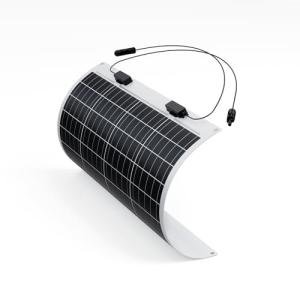
Each panel measures 1140 x 460 x 2.5mm and is just 0.098 inches thin — thinner than a typical smartphone is wide. That slimness, combined with the flexible backing, is what makes these panels installable on surfaces where rigid panels would simply fall off.
The Flexibility Factor: More Useful Than It Sounds
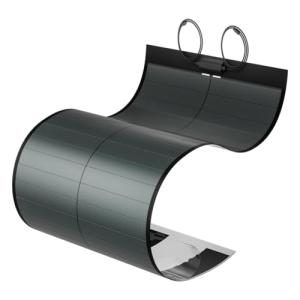
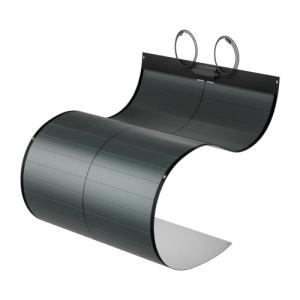
Flexible solar panels get dismissed by some enthusiasts as a novelty, but in the right application they're genuinely superior to rigid alternatives. These panels can be bent 30 to 40 degrees and installed on curved surfaces, which opens up a range of mounting options that glass panels can't touch.
Consider the typical RV roofline. Most modern motorhomes and trailers have at least some curve to their roof profile. A rigid panel has to be shimmed and angled to mount flush, creating wind drag and potential leak points at every mounting bracket. A flexible panel conforms to that curve, lies flat against the surface, reduces aerodynamic drag, and eliminates the need for raised mounting hardware. It's a fundamentally cleaner installation.
On boats and yachts, the advantage is even more pronounced. Deck surfaces curve in multiple directions, hatches and hardware create obstacles, and weight low on the vessel matters for stability. These panels can be adhesively mounted directly to fiberglass decking, keeping weight down and profile minimal.
XINPUGUANG positions the flexible panel as ideal for RV rooftops, campers, trailers, boats, cabins, sheds, and tents — essentially any outdoor application where portability and curved-surface installation are priorities.
Operating in the Real World: Temperature and Durability
Off-grid solar users tend to operate in the extremes — desert heat, mountain cold, coastal salt air, tropical humidity. The panels are rated for an operating temperature range of -45°C to 80°C (-49°F to 176°F), which covers virtually every environment a mobile user is likely to encounter. That -45°C lower limit is particularly impressive, covering Alaskan winters and high-altitude camping without issue.
The ETFE surface provides strong light transmittance, reaching 95%, and contains fluorine atoms bonded to the panel's EVA layer, which prevents delamination and discoloration over time. This is a meaningful durability advantage over PET-backed flexible panels, which are cheaper but prone to yellowing and surface degradation after prolonged UV exposure. ETFE is the same material used in high-end architectural glazing — it handles sun, rain, salt spray, and temperature cycling without breaking down.
The 30A Charge Controller: The Unsung Hero
A solar panel is only as useful as the charge controller managing its output. Send raw, unregulated solar power directly into a 12V battery bank and you'll boil the electrolyte and shorten the battery's life dramatically. The included 30A PWM controller handles that regulation automatically.
At 30A capacity on a 12V system, this controller can theoretically handle up to 360W of input — giving you headroom beyond the kit's 300W panel array. It supports both 12V and 24V battery banks, which means users can configure this kit into a 24V system if their boat or RV runs at that voltage. The alligator clip cables allow direct connection to exposed battery terminals, making this system functional even on older vessels or cabins where proper battery enclosures haven't been installed.
The controller is rated for 12V/24V systems, automatically detecting system voltage and adjusting charge parameters accordingly. This eliminates one common setup mistake among solar newcomers — accidentally wiring a 24V controller into a 12V system.
Real-World Output Expectations
Marketing specifications are measured under Standard Test Conditions — 1,000W/m² irradiance at 25°C. In the field, you'll typically see 70-85% of rated output during peak sun hours, depending on angle, temperature, and atmospheric conditions. From this 300W kit, expect realistic daily output of roughly 900Wh to 1,500Wh depending on your location and season — enough to run LED lighting, charge laptops and phones, power a 12V refrigerator, and keep navigation electronics running on a medium-sized sailboat.
For an RV, that output profile covers most essential loads during a typical warm-weather camping trip. Combined with a 100Ah lithium battery (sold separately), this kit provides a comfortable off-grid experience without generator dependency for most users.
Who This Kit Is — and Isn't — For
This system earns its place in the market for mobile, off-grid, and unconventional installations. It's the right choice for the liveaboard sailor who needs panels that can be mounted on a curved fiberglass deck without drilling dozens of holes. It works well for the weekend RV camper who wants a turnkey system they can install in an afternoon. It's appropriate for the off-grid cabin owner who needs a complete, affordable starter kit that doesn't require sourcing individual components.
It is not a substitute for a high-capacity residential ground mount system. Flexible panels sacrifice some long-term durability compared to tempered glass alternatives — they're more susceptible to physical puncture, and installation quality is more variable since they depend on adhesive bonding rather than mechanical mounting. For permanent, stationary installations on a fixed-pitch roof, rigid panels remain the better long-term investment.
Comparison: XINPUGUANG 300W Kit vs. Competing Flexible Solar Kits
| Feature | XINPUGUANG 300W Kit | ECO-WORTHY 260W Flexible Kit | Renogy 200W Flexible Kit |
|---|---|---|---|
| Total Output | 300W | 260W | 200W |
| Panel Type | Monocrystalline PERC | Monocrystalline 12BB | Monocrystalline |
| Cell Efficiency | ~19.5% | ~23.5% | ~22% |
| Panel Weight (each) | ~2.0kg | ~2.4kg | ~2.3kg |
| Bend Angle | 30–40° | 248° arc | 248° arc |
| Controller Included | Yes – 30A PWM | No | No |
| Cables Included | Full wiring set | No | No |
| Operating Temp | -45°C to +80°C | -40°C to +85°C | -40°C to +85°C |
| Surface Material | ETFE/fiberglass | ETFE | ETFE |
| Best Use Case | Full kit, RV/boat/cabin | High-efficiency flexible only | Premium brand, flexible only |
| Approx. Price Range | $$ | $$ | $$$ |
The comparison highlights a key differentiator: competing kits in this price range typically sell panels only, leaving you to source a compatible controller, connectors, and cables separately. The XINPUGUANG kit's all-in-one value proposition is real and meaningful for buyers who want a single purchase to get them operational.
Installation: Simpler Than Expected
The kit is designed to be portable, easy to install, and plug-and-play — a description that holds up in practice. The PV connectors are standard MC4-compatible fittings, meaning they work with virtually any third-party solar cable or expansion hardware. The parallel connector allows all three panels to be daisy-chained without any custom wiring.
XINPUGUANG has been developing and manufacturing solar panels since 2011, and that experience shows in the small details — the cable routing, the connector quality, and the overall system logic that makes this kit straightforward to deploy even for first-time solar installers.
The Bottom Line
The XINPUGUANG 300W Flexible Solar Kit is a well-thought-out product for a specific and underserved market. It won't replace a rooftop residential array, and it shouldn't try to. What it does — deliver 300 watts of flexible, lightweight, deployable solar power with everything needed to get a battery charging the same afternoon it arrives — it does reliably and at a price point that makes off-grid solar accessible to a much broader audience.
For the boater, the RV traveler, the remote cabin owner, or anyone who's looked at a curved or unconventional surface and wondered whether solar was even possible there, this kit is the answer worth considering first.
Specifications verified against manufacturer data. Real-world output varies based on installation angle, geographic location, shading, and ambient temperature.